Lauren Hersh speaks during a rally in support of the victims of Jeffrey Epstein outside the U.S. Capitol on Sept. 03, 2025 Credit - Andrew Harnik—Getty Images

This article is part of The D.C. Brief, TIME's politics newsletter. Sign uphereto get stories like this sent to your inbox.

The most unwilling sorority in the country met three months ago on the rooftop of a law firm, just a block away from the White House's campus. Survivors of convicted sex offenderJeffrey Epsteinand his accompliceGhislaine Maxwellmingled under the September dusk. Some were meeting each other for the first time. They had ostensibly gathered to make posters for the next day'srallyat the Capitol, but something more meaningful unfolded. Slowly, and without many words, the survivors came to understand their shared trauma and see around them a support network they didn't know they needed. The realization seemed to harden their resolve, and jelled into one of the most efficient political movements to hit Washington in decades.

"These victims have spoken. They've been very clear about who has caused them harm, and we need to believe these women," says Lauren Hersh, who founded World Without Exploitation to combat human trafficking and sexual exploitation in 2016. She was the organizer of the gathering, where she served as poster-board distributor and marker replacer. She is also one of the strategists whose efforts on behalf of the women on that roof and those like them helped upended the first year of President Donald Trump's second term.

In short order, these women helped force the hand of Congress, Trump, and all Americans to move toward disclosing the sins of Epstein and Maxwell—and possibly others in power. By Dec. 19, the Department of Justice must, by a bill passed by Congress and signed into law by Trump, disclose what it knows about the sex trafficking operations that sprawled across years and states. Three times this month, judges have sided with those who have asked to see previously secret grand jury records, in part opened because of the Trump-backed measure. And on Thursday, Senate Democratswroteto Justice's internal watchdog asking for an independent check to make sure everything is handled properly.

It has been a strikingly effective public affairs campaign, leading to a reversal that left even the most skeptical watchers in awe of the speed at which Republican reticence to engage on the Epstein saga evaporated. And yet, even among the champions of transparency, there is a lingering uncertainty about what exactly they might finally see come the deadline. After all, the law exempts materials that may identify victims or compromise ongoing investigations, and Trump has ordered a second look at the cases to see if certain politically active players were given special treatment.

"Your guess is as good as anybody else's," Hersh tells me. "We don't actually know what's going to come to light."

In the span of months, the pressure campaign yielded what other causes might have spent decades chasing. The billboards in targeted congressional districts forced lawmakers to go on the record with support—or not—for transparency. A constant shuttle of survivors to Capitol Hill for one-on-one meetings with anyone potentially standing in their way. An unexpected viral public service announcement that pierced Monday Night Football. A last-minute switch in Trump's attitude toward disclosure. A forcedvotein the House and a shockingly quick capitulation in the Senate. All of it came together in the last few months to prove that, at least in this case, Washington will heed constituents' demands.

"For far too long, the survivors were kept siloed, sidelined, and silenced. And when they came together, they broke the silence collectively," Hersh says. "Ultimately, their collective voice really cracked open the public conversation, which exerted pressure on Congress."

Lauren Hersh speaks during a rally in support of the victims of Jeffrey Epstein outside the U.S. Capitol on Sept. 03, 2025<span class= Andrew Harnik—Getty Images" style="max-width:100%; height:auto; border-radius:6px; margin:10px 0;" loading="lazy" />

For years, the women were told there was no way the whole trove of information about Epstein would ever see the light of day. There were too many powerful and connected men allegedly involved. The survivors included minors, making any disclosures even dicier. Epstein, who firstfacedcriminal charges in 2006 related to sexual exploitation of minors, seemed to be a master at dodging accountability for a sex trafficking ring that involved bold-faced names and billionaires. He killed himself in a jail cell while he was awaiting more charges in 2019.

But things changed last year, as Trump was working his way back to the White House. Images of Trump and Epstein became ubiquitous again. Trump was running around the country,suggestingthat if voters put him back in the White House, he was "inclined" to release the Epstein files. It was bait for his MAGA base convinced that Epstein's past could entangle the likes of Bill Clinton or Bill Gates. And it worked.

But once back in office, Trump balked. He said disclosing what the government knew would hurt victims, unfairly name unproven co-conspirators, and embarrass tangential figures. That argument was especially jarring to many of Trump's true believers, who remain convinced a cabal of elites has been taking advantage of their status. With Rep. Marjorie Taylor Greene leading the charge, a handful of House Republicans joined Democrats in forcing the full body to take a vote on a disclosure bill. (Greene has since announced plans to resign from Congress next year after a very public break with Trump.)

Still, the march to this point has been uneven. And it's been one that Hersh's organization was not necessarily built to serve. As the largest anti-trafficking network in the nation—200 member organizations and counting—it runs a survivor bootcamp to help former victims tell their stories to shape policy going forward. But one of the participants this summer was an Epstein survivor who confessed to being exhausted by the return of Trump.

"This moment is deeply painful and distressing," she told Hersh as talk in the commentariat turned to a potential Maxwellpardon. She felt, frankly, alone.

Hersh understood there was only one response: "We're gonna bring people together."

That retreat begat the idea of a Sept. 3 rally. Reps. Thomas Massie and Ro Khanna, a Kentucky Republican and a Silicon Valley Democrat, were working on a bipartisan maneuver that would force into the open whatever the Department of Justice had in its filing cabinets. Survivors would speak beside lawmakers. It was an event destined to draw headlines.

But it was also potentially combustible. So the night before, Hersh and her pals at Boies Schiller Flexner, a powerhouse law firm, invited the survivors to the rooftop over on New York Avenue here in D.C. "There was this instant sisterhood that was really beautiful," Hersh said. Survivors of other unspeakable circles of exploitation got word of the evening and joined in solidarity. Among themselves, they developed an informal rallying cry:Alone I'm fearful, but together we are feared.

It also was an opportunity for the organizers to privately convey a warning to the survivors. "Everybody is going to want to divide you in this moment. If we're going to be successful, there can be no division amongst you," Hersh told them.

The next day on the steps of the U.S. Capitol, survivors took their turns attaching their names and faces to horrible experiences at the alleged hands of Epstein, Maxwell, and their comrades. It was one of the most moving and upsetting moments of advocacy in recent years, one that made it impossible for a lot of lawmakers to ignore.

"The truth is, Epstein had a free pass. He bragged about his powerful friends, including our current President, Donald Trump. It was his biggest brag, actually," survivor Chauntae Davies said.

From there, the survivors understood they had to keep the pressure on Congress. They were consistently on the Hill, lobbying lawmakers to rethink their fealty to Trump and his shove-it-down attitude toward the investigative files.

But the strategists understood they had to keep going. Hersch and her team hired film teams in Los Angeles and New York to interview survivors. But when they sat down to look at the footage collected on soundstages in those coastal caverns, they realized their best material came not from the scripted readings, but from the impromptu observations. "You don't really hear much of the script in the actual PSA because what ended up happening in the space was just so moving. These women came together, the raw emotion that surfaced because of the bond that they shared was so powerful," Hersh said months later. Initially, the ad was just going to go online. Once it went viral, it caught the eye of a donor—Linkedin co-founder Reid Hoffman—who helped it air during Monday Night Football, hours before House lawmakers were set to vote.

"There are about 1000 of us. It's time to bring the secrets out of the shadows. It's time to shine a light into the darkness," the survivors said in the one-minute spot.

Separately, the groups started to lease billboards in congressional districts where they thought they could force Republicans to either defect or defend the ongoing stonewalling from Justice. In Colorado Springs, where Rep. Lauren Boebert serves and deceased Epstein victim Virginia Giuffre still has family, drivers saw the "Courage is Contagious"messagingalong I-25. Boebert, a conservative firebrand who is typically in line with Trump, opted to defy the party andjoinwith Democrats in chasing the release of the Epstein files. Not even a meeting in the White House Situation Room could talk her away from her position.

A final press conference proved to be a gut punch to many lawmakers who were watching from their offices.

"We are fighting for the children," said survivor Haley Robson, who held up a photograph of herself as a young girl. "Choose the survivors. Choose the children."

"None of us here signed up for this political warfare," added survivor Wendy Avis. "We never asked to be dragged into battles between people who never protected us in the first place."

Another survivor, Jena-Lisa Jones, spoke directly to Trump. "I beg you, President Trump, please stop making this political. It is not about you, President Trump," she said into the camera. "I voted for you, but your behavior on this issue has been a national embarrassment."

Staring down defeat, Trump retreated. Although he continued to call it a "hoax," he publicly gave Republicans permission to vote for the release; only one voted against the measure.

The legislation cleared the Senate hours later unanimously. And Trump signed it into law that evening.

All the while, stunned survivors were on the Hill watching every development come at break-neck speed. "We never thought in a million years that it was going to move to the Senate as fast as it moved to the Senate," Hersh said.

Still, the next move is one controlled by the Justice Department, and this is one that takes its cues directly from the White House. Both Attorney General Pam Bondi and FBI Director Kash Patelsaidearlier this year that there was nothing else noteworthy worth releasing. But now Congress—and Trump—have ordered them to release "all unclassified records, documents, communications, and investigative materials" by next week.

The devil is in the details. If Bondi chooses to argue that they're still investigating Epstein-related manners, it could sidestep the prescribed transparency. Similarly, they could skirt disclosures in the name of protecting survivors. "We don't know how things shake out. I'll be very candid with you in telling you that this period of waiting is really distressing on the survivors," Hersh says. "They know what has come out. They know what hasn't come out."

On top of that, the survivors could find themselves in the coming days flipping through page after page of government documents that are just blocks of blacked-out material. Hersh is ready for that possibility, too. "If we get pages of redaction," she says, "you can be sure that our work will not be done."

Make sense of what matters in Washington.Sign up for the D.C. Brief newsletter.

Write toPhilip Elliott atphilip.elliott@time.com.

How Epstein's Victims Fought Trump and Found Each Other

Lauren Hersh speaks during a rally in support of the victims of Jeffrey Epstein outside the U.S. Capitol on Sept. 03, 2025 Credit - Andrew ...
What Cold? Parts Of The West Are Basking In Record Warmth This Week

Record warm mid-December temperatures are forecast for parts of the West through the weekend even as parts of the Midwest and East shiver in brutal cold.

Records Already Set

We've already seen some attention-grabbing highs in the West this week.

For example, the nation's hottest temperature Wednesday was in Southern California, where the Native American community of Pala in San Diego County soared to 91 degrees.

In the Southern California mountains, Big Bear set an all-time December record (72 degrees) Tuesday.

And even while beingsoaked by an atmospheric river, Seattle set arecord highof 53 degrees just before midnight late Tuesday night. Portland, Oregon, had a record warm low of 58 degrees on Wednesday, 11 degrees warmer than their averagehighfor the day.

Perhaps most weird, Yakima, Washington, despite being blanketed in clouds from the atmospheric river, tied their all-time December record high of 72 degrees Wednesday, only 1 degree cooler than the high in Las Vegas, which was in itself almost a daily record.

Current Temperatures Across The US

More To Come

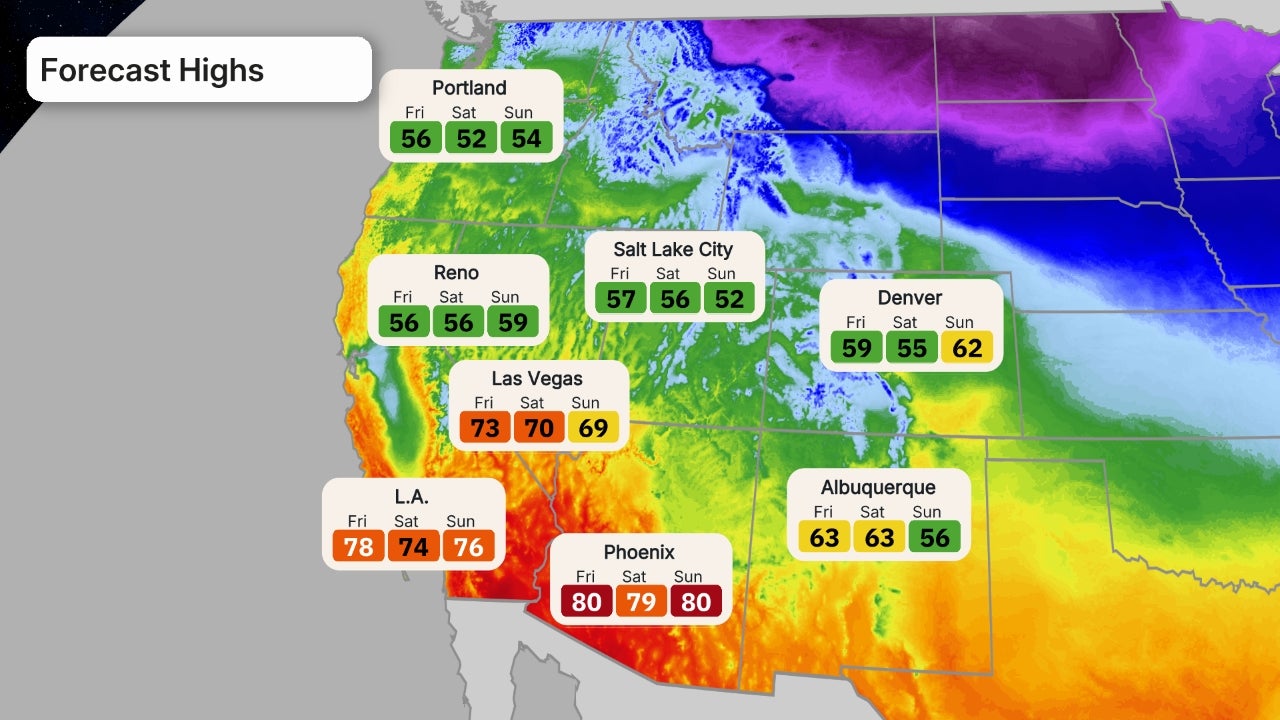
We're forecasting potential daily record high temperatures each day through this weekend in parts of the West, from the Great Basin to the Desert Southwest and California.

Want some highlights?

How about low 70s for highs in Las Vegas? It means you won't need to stay in the casinos, but can also enjoy a walk along The Strip without a jacket in the afternoon.

Better yet, how about upper 70s or 80s in L.A., Phoenix and Tucson. And we are months away from the start of the Cactus League.

And, frankly, highs in the 50s to near 60 in Portland, Salt Lake City and Reno are pretty awesome for mid-December.

This is all happening as the Midwest and East will feelanother brutal cold blast this weekend.

Maybe it's time for a quick getaway during a soft time in the schedule before Christmas travel kicks off next weekend. And if you're a retired "snowbird", why wait until after Christmas to migrate to Arizona?

(MAPS:10-Day US Forecast Highs/Lows)

Why So Warm?

There's often a yin and yang to temperatures across the country. If one area is colder than usual, another area is warmer.

In this case, the jet stream over the West Coast has bulged northward toward Washington state and British Columbia from high pressure. If this was summer, we'd probably call that high pressure area a "heat dome".

Near that ridge, air is slowly sinking, maximizing sunshine and keeping any Pacific storms and arctic air away from the Southwest. (Though as weather.com senior meteorologist Jonathan Bellespointed out, that sinking air is also contributing to stubborn fog in California's Central Valley known as "tule fog").

Like any wave, though, this western northward bulge in the jet means the jet nosedives into the Midwest and East, pulling cold air into those areas.

West record warmth

More Warm Than Cold Records, Again

Even with all these warm records in the West, there are fewer cold records threatened by the Midwest and East weekend cold snap.

While we certainly have had cold snaps set records, includingearly last month, 2025 has been another year dominated by warm records, so far.

According toNOAA statistics, there have been more than 2 daily warm records tied or set for every cold record so far in 2025 through December 8, as the graph below shows.

If we consider records set for a given month, that ratio rises to about 5 monthly warm records for any monthly cold record this year. And for all-time records, warm records in 2025 outnumber cold by 185 to 52, so far.

This skewed ratio is something seenincreasingly often this century, according to both Climate Central and research kicked off years ago by former The Weather Channel meteorologistGuy Walton.

This past meteorological fall — September through November — wasone of the nation's warmest in 131 years, NOAA calculated.

Data: NOAA/NCEI

Jonathan Erdman is a senior meteorologist at weather.com and has been covering national and international weather since 1996. Extreme and bizarre weather are his favorite topics. Reach out to him onBluesky,X (formerly Twitter)andFacebook.

What Cold? Parts Of The West Are Basking In Record Warmth This Week

Record warm mid-December temperatures are forecast for parts of the West through the weekend even as parts of the Midwest...
Putin offers 'solidarity' for Venezuelan people as tensions mount between Maduro and US

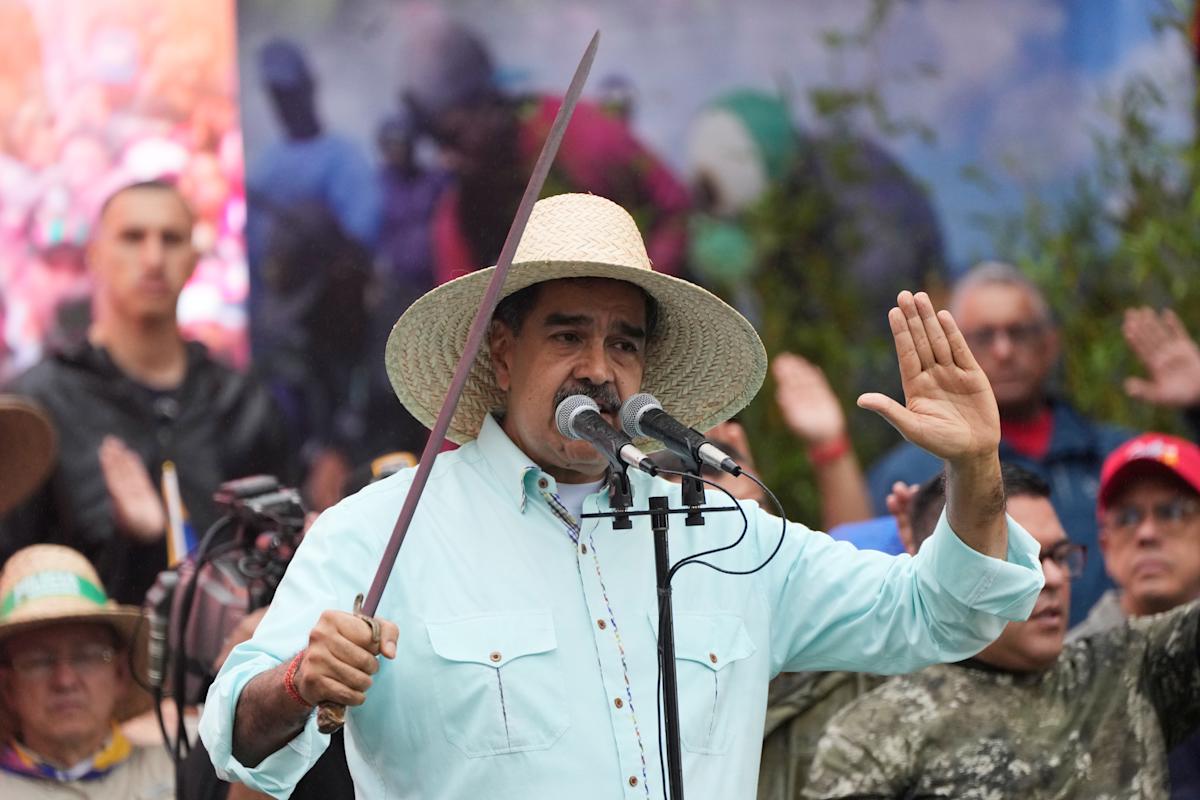
MOSCOW (AP) — Russian PresidentVladimir Putinexpressed "solidarity with the Venezuelan people" on Thursday amidgrowing tensionsbetween Venezuela's leader, Nicolás Maduro, and the Trump administration.

The Kremlin said in a statement that Putin spoke with Maduro by phone and reaffirmed his support for Venezuelan leader's policy of "protecting national interests and sovereignty in the face of growing external pressure."

The call comes a day afterAmerican forces seized an oil tanker offthe coast of Venezuela, the latest tactic from U.S. PresidentDonald Trump'sadministration to ramp up pressure on Maduro, who has beencharged with narcoterrorismin the United States.

Duringtestimony before Congress on Thursday, Homeland Security Secretary Kristi Noemlinked the seizure of the vesselto the Trump administration's anti-drug efforts in the region. The U.S. has built up its largest military presence in the region in decades and launched a series ofdeadly strikes on alleged drug-smuggling boats.

Maduro has insisted the real purpose of the U.S. military operations is to force him from office. Venezuela's government said the tanker seizure "constitutes a blatant theft and an act of international piracy."

The South American country's government said that Putin had "categorically reaffirmed his support" for Maduro in their call.

It said in a statement that Putin had told Maduro that direct communication between Moscow and Caracas would "remain permanently open" and Russia would continue to support Venezuela "in its struggle to assert its sovereignty, international law, and peace throughout Latin America."

Like his predecessor, the late President Hugo Chávez, Maduro has forged a close relationship with Russia, which has offered Venezuela help, ranging from coronavirus vaccines to the design of a cryptocurrency. In 2018, it also briefly dispatched a pair of nuclear-capable Tu-160 bombers to the airport outside Venezuela's capital amid soaring Russia-U.S. tensions.

Last year, two Russian naval ships docked in the Venezuelan port of La Guaira after exercises in the Atlantic Ocean that Moscow said were to "show the flag" in remote, important regions.

In Belarus, authoritarian President Alexander Lukashenko, a Putin ally, met with the Venezuelan ambassador to Russia, Jesus Rafael Salazar Velázquez, on Thursday, for the second time in just over two weeks.

Details of what was discussed were not revealed, but Belarus' state news agency Belta quoted Lukashenko as saying that the diplomat was expected to discuss "certain issues" with Maduro after their first meeting on Nov. 25 and to travel to Belarus again, so that they could reach "a certain decision."

During the November meeting, Lukashenko extended an invitation to Maduro to visit Belarus, and said that he would try and find the time to visit Venezuela, too.

Putin offers 'solidarity' for Venezuelan people as tensions mount between Maduro and US

MOSCOW (AP) — Russian PresidentVladimir Putinexpressed "solidarity with the Venezuelan people" on Thursday amid...

Lauren Hersh speaks during a rally in support of the victims of Jeffrey Epstein outside the U.S. Capitol on Sept. 03, 2025 Credit - Andrew Harnik—Getty Images

This article is part of The D.C. Brief, TIME's politics newsletter. Sign uphereto get stories like this sent to your inbox.

The most unwilling sorority in the country met three months ago on the rooftop of a law firm, just a block away from the White House's campus. Survivors of convicted sex offenderJeffrey Epsteinand his accompliceGhislaine Maxwellmingled under the September dusk. Some were meeting each other for the first time. They had ostensibly gathered to make posters for the next day'srallyat the Capitol, but something more meaningful unfolded. Slowly, and without many words, the survivors came to understand their shared trauma and see around them a support network they didn't know they needed. The realization seemed to harden their resolve, and jelled into one of the most efficient political movements to hit Washington in decades.

"These victims have spoken. They've been very clear about who has caused them harm, and we need to believe these women," says Lauren Hersh, who founded World Without Exploitation to combat human trafficking and sexual exploitation in 2016. She was the organizer of the gathering, where she served as poster-board distributor and marker replacer. She is also one of the strategists whose efforts on behalf of the women on that roof and those like them helped upended the first year of President Donald Trump's second term.

In short order, these women helped force the hand of Congress, Trump, and all Americans to move toward disclosing the sins of Epstein and Maxwell—and possibly others in power. By Dec. 19, the Department of Justice must, by a bill passed by Congress and signed into law by Trump, disclose what it knows about the sex trafficking operations that sprawled across years and states. Three times this month, judges have sided with those who have asked to see previously secret grand jury records, in part opened because of the Trump-backed measure. And on Thursday, Senate Democratswroteto Justice's internal watchdog asking for an independent check to make sure everything is handled properly.

It has been a strikingly effective public affairs campaign, leading to a reversal that left even the most skeptical watchers in awe of the speed at which Republican reticence to engage on the Epstein saga evaporated. And yet, even among the champions of transparency, there is a lingering uncertainty about what exactly they might finally see come the deadline. After all, the law exempts materials that may identify victims or compromise ongoing investigations, and Trump has ordered a second look at the cases to see if certain politically active players were given special treatment.

"Your guess is as good as anybody else's," Hersh tells me. "We don't actually know what's going to come to light."

In the span of months, the pressure campaign yielded what other causes might have spent decades chasing. The billboards in targeted congressional districts forced lawmakers to go on the record with support—or not—for transparency. A constant shuttle of survivors to Capitol Hill for one-on-one meetings with anyone potentially standing in their way. An unexpected viral public service announcement that pierced Monday Night Football. A last-minute switch in Trump's attitude toward disclosure. A forcedvotein the House and a shockingly quick capitulation in the Senate. All of it came together in the last few months to prove that, at least in this case, Washington will heed constituents' demands.

"For far too long, the survivors were kept siloed, sidelined, and silenced. And when they came together, they broke the silence collectively," Hersh says. "Ultimately, their collective voice really cracked open the public conversation, which exerted pressure on Congress."

Lauren Hersh speaks during a rally in support of the victims of Jeffrey Epstein outside the U.S. Capitol on Sept. 03, 2025<span class= Andrew Harnik—Getty Images" style="max-width:100%; height:auto; border-radius:6px; margin:10px 0;" loading="lazy" />

For years, the women were told there was no way the whole trove of information about Epstein would ever see the light of day. There were too many powerful and connected men allegedly involved. The survivors included minors, making any disclosures even dicier. Epstein, who firstfacedcriminal charges in 2006 related to sexual exploitation of minors, seemed to be a master at dodging accountability for a sex trafficking ring that involved bold-faced names and billionaires. He killed himself in a jail cell while he was awaiting more charges in 2019.

But things changed last year, as Trump was working his way back to the White House. Images of Trump and Epstein became ubiquitous again. Trump was running around the country,suggestingthat if voters put him back in the White House, he was "inclined" to release the Epstein files. It was bait for his MAGA base convinced that Epstein's past could entangle the likes of Bill Clinton or Bill Gates. And it worked.

But once back in office, Trump balked. He said disclosing what the government knew would hurt victims, unfairly name unproven co-conspirators, and embarrass tangential figures. That argument was especially jarring to many of Trump's true believers, who remain convinced a cabal of elites has been taking advantage of their status. With Rep. Marjorie Taylor Greene leading the charge, a handful of House Republicans joined Democrats in forcing the full body to take a vote on a disclosure bill. (Greene has since announced plans to resign from Congress next year after a very public break with Trump.)

Still, the march to this point has been uneven. And it's been one that Hersh's organization was not necessarily built to serve. As the largest anti-trafficking network in the nation—200 member organizations and counting—it runs a survivor bootcamp to help former victims tell their stories to shape policy going forward. But one of the participants this summer was an Epstein survivor who confessed to being exhausted by the return of Trump.

"This moment is deeply painful and distressing," she told Hersh as talk in the commentariat turned to a potential Maxwellpardon. She felt, frankly, alone.

Hersh understood there was only one response: "We're gonna bring people together."

That retreat begat the idea of a Sept. 3 rally. Reps. Thomas Massie and Ro Khanna, a Kentucky Republican and a Silicon Valley Democrat, were working on a bipartisan maneuver that would force into the open whatever the Department of Justice had in its filing cabinets. Survivors would speak beside lawmakers. It was an event destined to draw headlines.

But it was also potentially combustible. So the night before, Hersh and her pals at Boies Schiller Flexner, a powerhouse law firm, invited the survivors to the rooftop over on New York Avenue here in D.C. "There was this instant sisterhood that was really beautiful," Hersh said. Survivors of other unspeakable circles of exploitation got word of the evening and joined in solidarity. Among themselves, they developed an informal rallying cry:Alone I'm fearful, but together we are feared.

It also was an opportunity for the organizers to privately convey a warning to the survivors. "Everybody is going to want to divide you in this moment. If we're going to be successful, there can be no division amongst you," Hersh told them.

The next day on the steps of the U.S. Capitol, survivors took their turns attaching their names and faces to horrible experiences at the alleged hands of Epstein, Maxwell, and their comrades. It was one of the most moving and upsetting moments of advocacy in recent years, one that made it impossible for a lot of lawmakers to ignore.

"The truth is, Epstein had a free pass. He bragged about his powerful friends, including our current President, Donald Trump. It was his biggest brag, actually," survivor Chauntae Davies said.

From there, the survivors understood they had to keep the pressure on Congress. They were consistently on the Hill, lobbying lawmakers to rethink their fealty to Trump and his shove-it-down attitude toward the investigative files.

But the strategists understood they had to keep going. Hersch and her team hired film teams in Los Angeles and New York to interview survivors. But when they sat down to look at the footage collected on soundstages in those coastal caverns, they realized their best material came not from the scripted readings, but from the impromptu observations. "You don't really hear much of the script in the actual PSA because what ended up happening in the space was just so moving. These women came together, the raw emotion that surfaced because of the bond that they shared was so powerful," Hersh said months later. Initially, the ad was just going to go online. Once it went viral, it caught the eye of a donor—Linkedin co-founder Reid Hoffman—who helped it air during Monday Night Football, hours before House lawmakers were set to vote.

"There are about 1000 of us. It's time to bring the secrets out of the shadows. It's time to shine a light into the darkness," the survivors said in the one-minute spot.

Separately, the groups started to lease billboards in congressional districts where they thought they could force Republicans to either defect or defend the ongoing stonewalling from Justice. In Colorado Springs, where Rep. Lauren Boebert serves and deceased Epstein victim Virginia Giuffre still has family, drivers saw the "Courage is Contagious"messagingalong I-25. Boebert, a conservative firebrand who is typically in line with Trump, opted to defy the party andjoinwith Democrats in chasing the release of the Epstein files. Not even a meeting in the White House Situation Room could talk her away from her position.

A final press conference proved to be a gut punch to many lawmakers who were watching from their offices.

"We are fighting for the children," said survivor Haley Robson, who held up a photograph of herself as a young girl. "Choose the survivors. Choose the children."

"None of us here signed up for this political warfare," added survivor Wendy Avis. "We never asked to be dragged into battles between people who never protected us in the first place."

Another survivor, Jena-Lisa Jones, spoke directly to Trump. "I beg you, President Trump, please stop making this political. It is not about you, President Trump," she said into the camera. "I voted for you, but your behavior on this issue has been a national embarrassment."

Staring down defeat, Trump retreated. Although he continued to call it a "hoax," he publicly gave Republicans permission to vote for the release; only one voted against the measure.

The legislation cleared the Senate hours later unanimously. And Trump signed it into law that evening.

All the while, stunned survivors were on the Hill watching every development come at break-neck speed. "We never thought in a million years that it was going to move to the Senate as fast as it moved to the Senate," Hersh said.

Still, the next move is one controlled by the Justice Department, and this is one that takes its cues directly from the White House. Both Attorney General Pam Bondi and FBI Director Kash Patelsaidearlier this year that there was nothing else noteworthy worth releasing. But now Congress—and Trump—have ordered them to release "all unclassified records, documents, communications, and investigative materials" by next week.

The devil is in the details. If Bondi chooses to argue that they're still investigating Epstein-related manners, it could sidestep the prescribed transparency. Similarly, they could skirt disclosures in the name of protecting survivors. "We don't know how things shake out. I'll be very candid with you in telling you that this period of waiting is really distressing on the survivors," Hersh says. "They know what has come out. They know what hasn't come out."

On top of that, the survivors could find themselves in the coming days flipping through page after page of government documents that are just blocks of blacked-out material. Hersh is ready for that possibility, too. "If we get pages of redaction," she says, "you can be sure that our work will not be done."

Make sense of what matters in Washington.Sign up for the D.C. Brief newsletter.

Write toPhilip Elliott atphilip.elliott@time.com.

How Epstein's Victims Fought Trump and Found Each Other

Lauren Hersh speaks during a rally in support of the victims of Jeffrey Epstein outside the U.S. Capitol on Sept. 03, 2025 Credit - Andrew ...
What Cold? Parts Of The West Are Basking In Record Warmth This Week

Record warm mid-December temperatures are forecast for parts of the West through the weekend even as parts of the Midwest and East shiver in brutal cold.

Records Already Set

We've already seen some attention-grabbing highs in the West this week.

For example, the nation's hottest temperature Wednesday was in Southern California, where the Native American community of Pala in San Diego County soared to 91 degrees.

In the Southern California mountains, Big Bear set an all-time December record (72 degrees) Tuesday.

And even while beingsoaked by an atmospheric river, Seattle set arecord highof 53 degrees just before midnight late Tuesday night. Portland, Oregon, had a record warm low of 58 degrees on Wednesday, 11 degrees warmer than their averagehighfor the day.

Perhaps most weird, Yakima, Washington, despite being blanketed in clouds from the atmospheric river, tied their all-time December record high of 72 degrees Wednesday, only 1 degree cooler than the high in Las Vegas, which was in itself almost a daily record.

Current Temperatures Across The US

More To Come

We're forecasting potential daily record high temperatures each day through this weekend in parts of the West, from the Great Basin to the Desert Southwest and California.

Want some highlights?

How about low 70s for highs in Las Vegas? It means you won't need to stay in the casinos, but can also enjoy a walk along The Strip without a jacket in the afternoon.

Better yet, how about upper 70s or 80s in L.A., Phoenix and Tucson. And we are months away from the start of the Cactus League.

And, frankly, highs in the 50s to near 60 in Portland, Salt Lake City and Reno are pretty awesome for mid-December.

This is all happening as the Midwest and East will feelanother brutal cold blast this weekend.

Maybe it's time for a quick getaway during a soft time in the schedule before Christmas travel kicks off next weekend. And if you're a retired "snowbird", why wait until after Christmas to migrate to Arizona?

(MAPS:10-Day US Forecast Highs/Lows)

Why So Warm?

There's often a yin and yang to temperatures across the country. If one area is colder than usual, another area is warmer.

In this case, the jet stream over the West Coast has bulged northward toward Washington state and British Columbia from high pressure. If this was summer, we'd probably call that high pressure area a "heat dome".

Near that ridge, air is slowly sinking, maximizing sunshine and keeping any Pacific storms and arctic air away from the Southwest. (Though as weather.com senior meteorologist Jonathan Bellespointed out, that sinking air is also contributing to stubborn fog in California's Central Valley known as "tule fog").

Like any wave, though, this western northward bulge in the jet means the jet nosedives into the Midwest and East, pulling cold air into those areas.

West record warmth

More Warm Than Cold Records, Again

Even with all these warm records in the West, there are fewer cold records threatened by the Midwest and East weekend cold snap.

While we certainly have had cold snaps set records, includingearly last month, 2025 has been another year dominated by warm records, so far.

According toNOAA statistics, there have been more than 2 daily warm records tied or set for every cold record so far in 2025 through December 8, as the graph below shows.

If we consider records set for a given month, that ratio rises to about 5 monthly warm records for any monthly cold record this year. And for all-time records, warm records in 2025 outnumber cold by 185 to 52, so far.

This skewed ratio is something seenincreasingly often this century, according to both Climate Central and research kicked off years ago by former The Weather Channel meteorologistGuy Walton.

This past meteorological fall — September through November — wasone of the nation's warmest in 131 years, NOAA calculated.

Data: NOAA/NCEI

Jonathan Erdman is a senior meteorologist at weather.com and has been covering national and international weather since 1996. Extreme and bizarre weather are his favorite topics. Reach out to him onBluesky,X (formerly Twitter)andFacebook.

What Cold? Parts Of The West Are Basking In Record Warmth This Week

Record warm mid-December temperatures are forecast for parts of the West through the weekend even as parts of the Midwest...
Putin offers 'solidarity' for Venezuelan people as tensions mount between Maduro and US

MOSCOW (AP) — Russian PresidentVladimir Putinexpressed "solidarity with the Venezuelan people" on Thursday amidgrowing tensionsbetween Venezuela's leader, Nicolás Maduro, and the Trump administration.

The Kremlin said in a statement that Putin spoke with Maduro by phone and reaffirmed his support for Venezuelan leader's policy of "protecting national interests and sovereignty in the face of growing external pressure."

The call comes a day afterAmerican forces seized an oil tanker offthe coast of Venezuela, the latest tactic from U.S. PresidentDonald Trump'sadministration to ramp up pressure on Maduro, who has beencharged with narcoterrorismin the United States.

Duringtestimony before Congress on Thursday, Homeland Security Secretary Kristi Noemlinked the seizure of the vesselto the Trump administration's anti-drug efforts in the region. The U.S. has built up its largest military presence in the region in decades and launched a series ofdeadly strikes on alleged drug-smuggling boats.

Maduro has insisted the real purpose of the U.S. military operations is to force him from office. Venezuela's government said the tanker seizure "constitutes a blatant theft and an act of international piracy."

The South American country's government said that Putin had "categorically reaffirmed his support" for Maduro in their call.

It said in a statement that Putin had told Maduro that direct communication between Moscow and Caracas would "remain permanently open" and Russia would continue to support Venezuela "in its struggle to assert its sovereignty, international law, and peace throughout Latin America."

Like his predecessor, the late President Hugo Chávez, Maduro has forged a close relationship with Russia, which has offered Venezuela help, ranging from coronavirus vaccines to the design of a cryptocurrency. In 2018, it also briefly dispatched a pair of nuclear-capable Tu-160 bombers to the airport outside Venezuela's capital amid soaring Russia-U.S. tensions.

Last year, two Russian naval ships docked in the Venezuelan port of La Guaira after exercises in the Atlantic Ocean that Moscow said were to "show the flag" in remote, important regions.

In Belarus, authoritarian President Alexander Lukashenko, a Putin ally, met with the Venezuelan ambassador to Russia, Jesus Rafael Salazar Velázquez, on Thursday, for the second time in just over two weeks.

Details of what was discussed were not revealed, but Belarus' state news agency Belta quoted Lukashenko as saying that the diplomat was expected to discuss "certain issues" with Maduro after their first meeting on Nov. 25 and to travel to Belarus again, so that they could reach "a certain decision."

During the November meeting, Lukashenko extended an invitation to Maduro to visit Belarus, and said that he would try and find the time to visit Venezuela, too.

Putin offers 'solidarity' for Venezuelan people as tensions mount between Maduro and US

MOSCOW (AP) — Russian PresidentVladimir Putinexpressed "solidarity with the Venezuelan people" on Thursday amid...
New Photo - Brett Gardner's Son Miller Was Following In His Footsteps Before His Death

Brett Gardner's Son Miller Was Following In His Footsteps Before His Death


Before his sudden passing on Friday, March 21, 14-year-old Miller Gardner was staring at a bright athletic future. Miller, son of former New York Yankees star Brett Gardner, died while on a family vacation in Costa Rica last week. His preliminary cause of death was ruled as asphyxia after a possible intoxication after apparently ingesting some food. On Tuesday, March 25, CNN reported that Miller may have died from food poisoning.
Read More >> Full Article on Source: NEWZZ MAG
#ShowBiz #Celebriries #lifestyle #trends #JD Vance #Greenland #Resign #Hillary #Venezuela #Jasmine Crockett

Brett Gardner's Son Miller Was Following In His Footsteps Before His Death

Brett Gardner's Son Miller Was Following In His Footsteps Before His Death Before his sudden ...


VINCE JRNL © 2015 | Distributed By My Blogger Themes | Designed By Templateism.com