Venezuelans wonder who's in charge as Trump claims contact with Maduro's deputy

BUENOS AIRES, Argentina (AP) — Venezuelans on Saturday were scrambling to understand who is in charge of their country after a U.S. military operation thatcaptured President Nicolás Maduro.

President Donald Trump delivered a shocking pick: The United States, perhaps in coordination with one of Maduro's most trusted aides.

Delcy Rodríguez has served as Maduro's vice president since 2018, overseeing much of Venezuela's oil-dependent economy as well as itsfeared intelligence service. But she is someone the Trump administrationapparently is willing to work with, at least for now.

"She's essentially willing to do what we think is necessary to make Venezuela great again," Trump told reporters of Rodríguez, who faced U.S. sanctions during Trump's first administration for her role in undermining Venezuelan democracy.

In a major snub, Trump said opposition leader Maria Corina Machado, who wasawarded last year's Nobel Peace Prize, didn't have the support to run the country.

Trump said Rodríguez had a long conversation with Secretary of State Marco Rubio in which Trump claimed she said, "'We'll do whatever you need.'"

"I think she was quite gracious," Trump added. "We can't take a chance that somebody else takes over Venezuela that doesn't have the good of the Venezuelan people in mind."

Rodríguez tried to project strength and unity among the ruling party's many factions, downplaying any hint of betrayal. In remarks on state TV, she demanded the immediate release of Maduro and his wife, Cilia Flores, and denounced the U.S. operation as a flagrant violation of the United Nations charter.

"There is only one president in this country, and his name is Nicolás Maduro," Rodríguez said, surrounded by top civilian officials and military commanders.

There was no immediate sign that the U.S. was running Venezuela.

"What will happen tomorrow? What will happen in the next hour? Nobody knows," Caracas resident Juan Pablo Petrone said.

No sign of a swearing-in

Trump indicated that Rodríguez had been sworn in already as president of Venezuela, per the transfer of power outlined in the constitution. However, state television has not broadcast any swearing-in ceremony.

In her televised address, Rodríguez did not declare herself acting president or mention a political transition. A ticker at the bottom of the screen identified her as the vice president. She gave no sign that she would be cooperating with the U.S.

"What is being done to Venezuela is an atrocity that violates international law," she said. "History and justice will make the extremists who promoted this armed aggression pay."

The Venezuelan constitution also says a new election must be called within a month in the event of the president's absence.

But experts have been debating whether the succession scenario would apply here, given the government'slack of popular legitimacyand theextraordinary U.S. military intervention.

Venezuelan military officials were quick to project defiance in video messages.

"They have attacked us but will not break us," said Defense Minister Gen. Vladimir Padrino López, dressed in fatigues.

Interior Minister Diosdado Cabello appeared on state TV in a helmet and flak jacket, urging Venezuelans to "trust in the political leadership and military" and "get out on the streets" to defend the country's sovereignty.

"These rats attacked and they will regret what they did," he said of the U.S.

Strong ties with Wall Street

A lawyer educated in Britain and France, Rodríguez has a long history of representing the revolution started by thelate Hugo Chávezon the world stage.

She and her brother, Jorge Rodríguez, head of theMaduro-controlled National Assembly, have strong leftist credentials born from tragedy. Their father was a socialist leader who died in police custody in the 1970s, a crime that shook many activists of the era, including a young Maduro.

Unlike many in Maduro's inner circle, the Rodríguez siblings have avoided criminal indictment in the U.S. Delcy Rodríguez has developed strong ties with Republicans in the oil industry and on Wall Street who balked at the notion of U.S.-led regime change.

Among her past interlocutors was Blackwater founder Erik Prince and, more recently, Richard Grenell, a Trump special envoy who tried to negotiate a deal with Maduro for greater U.S. influence in Venezuela.

Fluent in English, Rodríguez is sometimes portrayed as a well-educated moderate in contrast to the military hardliners who took up arms with Chávez against Venezuela's democratically elected president in the 1990s.

Many of them, especially Cabello, are wanted in the U.S. on drug trafficking charges and stand accused of serious human rights abuses. But they continue to hold sway over the armed forces, the traditional arbiter of political disputes in Venezuela.

That presents major challenges to Rodríguez asserting authority. But experts say that Venezuela's power brokers have long had a habit of closing ranks behind their leaders.

"These leaders have all seen the value of staying united. Cabello has always taken a second seat or third seat, knowing that his fate is tied up with Maduro's, and now he very well might do that again," said David Smilde, a sociology professor at Tulane University who has conducted research into Venezuela's political dynamics over the past three decades.

"A lot depends on what happened last night, which officials were taken out, what the state of the military looks like now," Smilde said. "If it doesn't have much firepower anymore, they're more vulnerable and diminished and it will be easier for her to gain control."

An apparent snub of the opposition

Shortly before Trump's press conference, Machado, the opposition leader, called on her allyEdmundo González— a retired diplomat widely considered to have won thecountry's disputed 2024 presidential election— to "immediately assume his constitutional mandate and be recognized as commander-in-chief."

In an triumphant statement, Machado promised that her movement would "restore order, freepolitical prisoners, build an exceptional country and bring our children back home."

She added: "Today we are prepared to assert our mandate and take power."

Asked about Machado, Trump was blunt: "I think it would be very tough for (Machado) to be the leader," he said.

"She doesn't have the support or respect within the country."

Venezuelans expressed shock, with many speculating on social media that Trump had mixed up the two women's names. Machado has not responded to Trump's remarks.

Goodman reported from Miami.

Venezuelans wonder who's in charge as Trump claims contact with Maduro's deputy

BUENOS AIRES, Argentina (AP) — Venezuelans on Saturday were scrambling to understand who is in charge of their country af...
Tears, relief and questions about what comes next: Venezuelans in U.S. celebrate Maduro capture

DORAL, Fla. — They came out in the middle of the night when they heard the news, some still in pajamas as they joined the crowd of revelers waving Venezuelan flags and dancing, singing and crying.

"Thank you, Lord, thank you president of the United States. I've been waiting for years — he's done so much damage. This has been horrible," said Yajaira, a Venezuelan American from the city of Maracaibo.

The newsthat the U.S. had attacked Venezuelaand captured President Nicolás Maduro and his wife elicited a spontaneous celebration in front of El Arepazo, a restaurant in Doral, a city in Miami-Dade County nicknamed "Doralzuela" because it hasthe highest concentration of Venezuelansin the U.S.

"We've been here eight years, eight years already," Yajaira said, referring to how long she's been in the U.S. "They killed my older brother. It was so tough. They kidnapped my brothers. That was tough. I thank God for all of this because it's been tough," she said, her voice breaking as she looked up at the sky.

Throughout the morning, the growing crowds in Doral were chanting in Spanish, "The government is over, the government has fallen," amid the blasting car horns and music.

Venezuelans started coming to Florida and the U.S. in large numbers in the early 2000s after socialist Hugo Chávez rose to power. The situation deteriorated drastically when Maduro took over in 2013. Under Maduro, the country's oil-driven economyhas faced a decadelong collapseand an estimated 80% of residents live in poverty. Around 8 million Venezuelans have fled under his rule.

President Donald Trump said the U.S. is "going to run" Venezuela following Maduro's capture "until such time as a safe, proper and judicious transition can take place." He said Venezuelan Vice President Delcy Rodriguez has been sworn is as president;she has called for Maduro's release.

People celebrate on the streets.  (Giorgio Viera / AFP - Getty Images)

Diana Monert, also celebrating in Doral, was asked what the recent events mean for Venezuelans. "Freedom," she said.

The relief and jubilation stretched across other parts of the country. In Cincinnati, Rosaly Navas, 43, a property manager, said, "My heart is racing — this is the biggest miracle that has happened in my lifetime. ... I have spent so many hours awake and I really want to contribute to recovering my country."

Questions over what happens next

Amid the relief among some Venezuelan Americans that Maduro was no longer in power, there were questions and concerns about what happens next, with several noting that other top officials in Venezuela had not been captured.

A young man celebrating in front of El Arepazo who did not want to give his name because he was worried about his family in Venezuela said it was "the biggest day we were waiting for. ... I'm really happy. We were waiting for the end of that dictatorship."

When asked how his family in Venezuela was doing, he said, "They're excited but at the same time they have fear, they're waiting for what's going to happen — what's going to be the next step."

Patricia Andrade, who helps newly arrived migrants through her Miami nonprofit Raices Venezolanas, said she has mixed feelings.

"I spent years waiting for the Chavez-Maduro regime to fall," she said.

While it has given her great happiness to see Maduro in U.S. custody, there are still many more Venezuelan officials to be arrested, she said.

Adelys Ferro, executive director of the Venezuelan American Caucus, a grassroots group working to amplify Venezuelan American voices and issues in the U.S., said she was celebrating that "justice is taking its course and that Maduro responds for all the crimes he's committed."

But she warned that "Venezuela is still not free from Chavismo," referring to the government's socialist rule started by Chávez. "I hope that the innocents, the good people in Venezuela, who are the majority, will be protected," she said.

People celebrate on the street. (Giorgio Viera / AFP - Getty Images)

Ferro added that she hopes "Trump understands Venezuelans here in the U.S. also fled and need protection. It's no time for more attacks and persecution of Venezuelan immigrants. Those people fled a dictatorship and they're not Tren de Aragua."

Ferro noted more than 6 in 10 Venezuelans in the U.S. came through temporary protected status, which the Trump administration has rescinded. She also urged Trump to recognize that there's a need for bipartisan support for Venezuelans. "What we need is support in this critical moment," she said.

'Something was coming'

In Venezuela, a resident who didn't want to be named for their own safety said, "We had different tips that something was coming, Trump had already announced something," adding the events reminded them of the late writer Gabriel García Márquez's novel "Chronicle of a Death Foretold."

Speaking hours after the attack, the Venezuelan resident said "nobody is in support of the invasion, the violence, but we aren't also in support of the people who didn't win the election," referring to Maduro, who remained in powerdespite credible evidence that his opponent won the 2024 election.

"We are humble citizens — we're caught. How is it possible that they took they took the president and his wife? Was it someone who betrayed him? There is so much uncertainty and so much fear," the resident said. "I'm very impressed that they just took him."

Yanire Lucas, a Caracas resident,told The Associated Pressshe was scared to even leave the house. "What is happening is unprecedented," Lucas said. "We're still on edge, and now we're uncertain about what to do. Stay safe at home, go out to look for food? I don't know."

Trump's statement that the U.S. would "run" Venezuela is opening up a host of questions over what will happen in the next few days and months.

But in Doral, before the president's statements, Yajaira was asked what message she had for other Venezuelans following the U.S. attack and Maduro's capture.

"Be strong, sí se puede [yes we can]" Yajaira said. "We're going to be a free, prosperous country."

Tears, relief and questions about what comes next: Venezuelans in U.S. celebrate Maduro capture

DORAL, Fla. — They came out in the middle of the night when they heard the news, some still in pajamas as they joined the...
How the US captured Venezuelan leader Nicolás Maduro

WASHINGTON (AP) — For months, the U.S. military had been amassing a presence off Venezuela's coast and conspicuously blowing up alleged drug trafficking boats and killing the occupants.

At the same time, U.S. intelligence agencies were carefully studying the country's authoritarian PresidentNicolás Maduro, learning minute details such as his eating habits while special forces secretly rehearsed a plan to forcibly remove him.

Months of covert planning led to the brazen operation overnight, when PresidentDonald Trumpgave an order authorizing Maduro's capture. The U.S. plunged the South American country's capital into darkness, infiltrated Maduro's home and whisked him to the United States, where the Trump administration planned toput him on trial.

Trump, during a news conference Saturday at his Florida home, laid out the details of the strike, after which he said Maduro and his wife, Cilia Flores, were flown by helicopter to a U.S. warship.

The operation termed "Absolute Resolve" unfolded under the cover of darkness, with U.S. forces holding fast in the region, awaiting the ideal weather conditions to give pilots clear routes into Caracas. The extensive planning included practice on a replica of the presidential compound, as well as U.S. service members armed with what Trump said were "massive blowtorches" in the event the steel walls of a safe room needed to be cut open to extract the pair.

"He didn't get that space closed. He was trying to get into it, but he got bum-rushed right so fast that he didn't get into that," Trump said an interview earlier Saturday morning on "Fox & Friends Weekend."

A carefully rehearsed mission

Gen. Dan Caine, chairman of the Joint Chiefs of Staff, said at Trump's news conference that U.S. forces had rehearsed their maneuvers for months, learning everything about Maduro — where he was at certain hours as well as details of his pets and the clothes he wore.

"We think, we develop, we train, we rehearse, we debrief, we rehearse again, and again," Caine said, saying his forces were "set" by early December. "Not to get it right, but to ensure we cannot get it wrong."

Trump said on Fox that U.S. forces had practiced their extraction on a replica building.

"They actually built a house which was identical to the one they went into with all the same, all that steel all over the place," Trump said.

Trump said in the television interview that U.S. forces held off on conducting the operation for days, waiting four days for cloud cover to pass. Caine said that on Friday night, "the weather broke just enough, clearing a path that only the most skilled aviators in the world could move through," adding that helicopters flew low to the water to enter Venezuela and were covered above by protective U.S. aircraft.

Trump said the U.S. operation "was dark and it was deadly," adding that "the lights of Caracas were largely turned off due to a certain expertise that we have," but giving no further details.

The attack, which Defense Secretary Pete Hegseth described as part of "massive joint military and law enforcement raid," lasted less than 30 minutes. At least seven explosions were heard in Caracas, and Venezuela's Vice President Delcy Rodríguez, who under law takes power, said some Venezuelan civilians and members of the military were killed.

In a televised address later Saturday on state television, she demanded that the U.S. free Maduro and called him the country's rightful leader. But Rodríguez also left open the door for a dialogue with the U.S. when she said, "We are willing to have respectful relations."

Yanire Lucas, a Caracas resident whose house sits pressed up next to a Venezuelan military base struck overnight, said she began to hear explosions next to her house around 1:50 in the morning.

Trump said a few U.S. members in the operation were injured, but he believed no one was killed. Caine said one helicopter was struck by fire as it closed in on Maduro's compound but it was able to safely fly on its return.

Months of escalating actions

Trump said Maduro and Flores were flown by helicopter to a U.S. warship and would go on to New York to face charges. He posted on Truth Social a photo of the Venezuelan leader, wearing a gray sweatsuit, protective headphones and blindfold.

The raid was a dramatic escalation from a series of strikes the U.S. military has carried out on what Trump has said were drug-carrying boats in the Caribbean Sea and eastern Pacific Ocean since early September. On Dec. 29, Trump said the U.S. struck a facility where boats accused of carrying drugs "load up." The CIA was behindthe drone strikeat a docking area believed to have been used by Venezuelan drug cartels, the first known direct operation on Venezuelan soil since the U.S. began its strikes in September.

Few details about how the US will now run Venezuela

Though Trump had warned for months that the U.S. might conduct strikes in Venezuela, he gave little hint on Friday what was coming.

He spent the morning posting on social media defending his health and complaining about the impact of wind turbines on birds before he went shopping for marble and onyx for the ballroom he's building at the White House and a visit to his golf club.

Privately, he was readying to give the go-ahead for a military mission that already has generated criticism in the U.S. and abroad. Now, the president said the U.S. will direct the path forward for Venezuela.

Trump said at his news conference that the group of officials standing behind him, including Hegseth, Caine and Secretary of State Marco Rubio, will "be a team that's working with the people of Venezuela."

The Republican president left open the possibility that U.S. troops would have a presence in the country. "We're not afraid of boots on the ground if we have to," he said, adding, "We had boots on the ground last night."

The U.S. will now "run" the country until a new leader can be chosen, Trump said.

"We're going to make sure that country is run properly. We're not doing this in vain," he said. "This is a very dangerous attack. This is an attack that could have gone very, very badly."

Kinnard reported from Chapin, South Carolina. Associated Press reporters Regina Garcia Cano and Juan Arraez in Caracas, Venezuela, contributed to this report.

How the US captured Venezuelan leader Nicolás Maduro

WASHINGTON (AP) — For months, the U.S. military had been amassing a presence off Venezuela's coast and conspicuously ...

California's rainy season has been living up to its name this year as more storms will continue to impact the state for the next several days.

I hate to sound like a broken record, but heavy rain, mountain snow and gusty winds are the main factors again for the waterlogged state.

Timing of Storms

Through Sunday: The first rounds of moisture will continue through the weekend, spreading across much of the state. The heaviest rainfall is expected across Northern California, with flood watches lasting through Sunday. Heavy snowfall is expected across the Sierra Nevada. High wind alerts are in place for most of Northern California, stretching to parts of Southern California.

Monday: Another storm system will approach, bringing another round of rain, snow and wind. This system is currently forecast to be weaker than the ones over the weekend, with only a level 1 of 4 threat of excessive rainfall for much of coastal California.

Tuesday: Much of the state will see drier conditions since the bulk of the lower-elevation rain and mountain is focused across the Pacific Northwest. Only Northern California can see some valley rain and mountain snow.

Wednesday - Friday: The forecast starts to get more uncertain here with some models showing signs of another storm system or two. Our data does show more rain and mountain snow for Northern California for at least Wednesday before the state will dry out by the weekend. Check back with us frequently as the forecast may change.

How Much Rain And Snow?

Widespread rainfall totals of 2-4 inches are possible with the Sierra foothills seeing 5-7 inches. Widespread winds to 50 mph could also cause some power outages and downed tree limbs.

Across the Sierra Nevada, snowfall totals through Monday morning could reach up to 5 feet. Winds could reach 100 mph across the peaks, so traveling in the mountains could be difficult to impossible.

Additional rain and mountain snow are expected from the systems this upcoming week. More details will be added as the forecast narrows.

Above Average Rainfall

This is the rainy season across the West, so if there were no rainfall, we would have a problem.

But, if you are wondering if it has been more than normal, you are correct.

We are seeing above-average rainfall this season. Let me give you a few cities below:

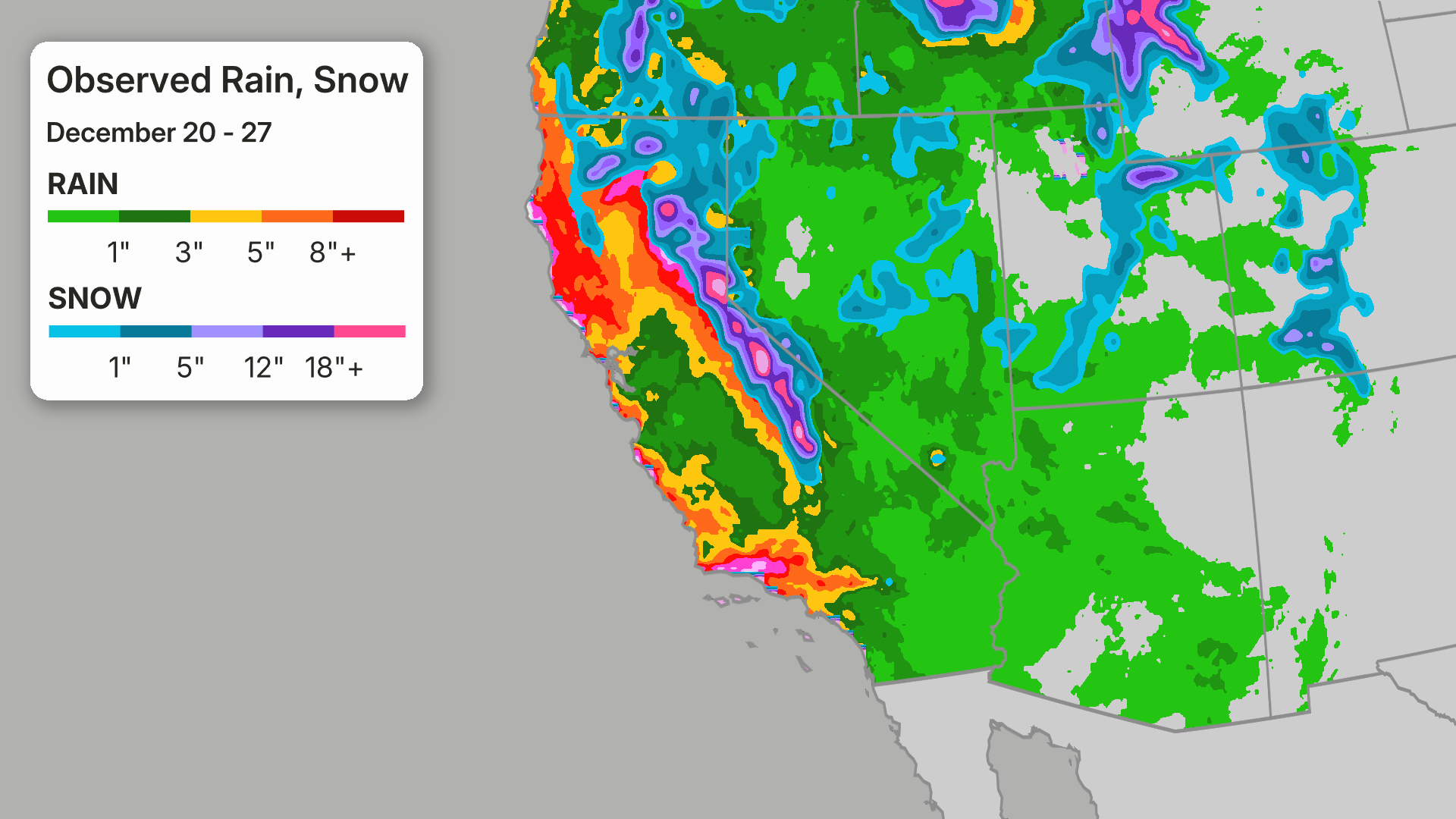
Los Angeles has seen an impressive 13.25 inches of rainfall since October 1. Their average is just over 4 inches. In fact, this is their 4th wettest October to January they have ever seen. A large portion of this rainfall fell the week of Christmas (see below graphic).

Christmas Week Rain and Snow across California.

For More:Atmospheric River Recap)

Downtown San Francisco has seen nearly 10 inches of rainfall since October 1. Not as impressive as Los Angeles, but the city is still running over an inch above average.

Redding has seen over 16 inches of rainfall since October 1, which is over 4 inches above average.

Snowpack Recovering

The California Snowpack is essential, not just for skiers but for the fresh water supply for the state.

And when the snowpack is underperforming, concern mounts.

This year was not off to a good start.

On December 19, 2025, the snowpack was just 12% of where it should have been, largely due to the above-average warmth that has been persisting across parts of the West this winter. The warmth only allowed snowfall across the highest elevations.

This pattern has shifted, and as of January 2, 2026, the snowpack has jumped to 69% of normal. Nature has work to do, but hopefully the latest snowfall will bring it even closer to average.

King Tides Impacts?

If the rounds of rain, snow and gusty winds weren't bad enough, California is also being impacted by King Tides.

King Tides typically occur when the moon is near full and at its closest point to Earth and can create devastating storm surge.

(MORE:King Tides)

Coastal flood alerts are in place across parts of California over the weekend, warning that potentially 2 feet or higher of inundation is possible, which could lead to flooding of coastal communities.

Rob Shackelford is a meteorologist and climate scientist at weather.com. He received his undergraduate and master's degrees from the University of Georgia studying meteorology and experimenting with alternative hurricane forecasting tools.

California Flood Threat Ongoing For Valleys And Coasts, Snowpack To Further Catch Up With More Storms Coming

California's rainy season has been living up to its name this year as more storms will continue to impact the state for the next several...

FILE - President Nicolas Maduro, accompanied by first lady Cilia Flores, greets supporters during an event marking the anniversary of a 1958 coup ousting dictator Marcos Pérez Jiménez, in Caracas, Venezuela, Jan. 23, 2024. Credit - Jesus Vargas—Associated Press

World leaders reacted to thecapture of Venezuelan President Nicolas Maduroby the United States with a mixture of outrage, concern, and caution on Saturday.

President Donald Trump announced the capture of Maduro and his wife, Cilia Flores, and a "large-scale" strike against Venezuela hours after explosions were reported in the country's capital, Caracas.

The extraordinary attack followsmonths of pressurefrom the Trump Administration on Maduro to cede power in the South American country over long-standing accusations of drug trafficking and election rigging.

Read more:Venezuela Isn't Panama—No Matter How Much Trump Wishes It Were

It represents the largest U.S. military operation in Latin America since the 1989 invasion of Panama, when, as today, the U.S. captured the country's leader, Manuel Antonio Noriega.

Many countries expressed outrage over the capture of Maduro on Saturday, while even some U.S. allies issued statements calling for the rule of law to be respected.

South American leaders in particular expressed anger at the attack.

Here is a round-up of global reaction to the operation.

United Kingdom

British Prime Minister Keir Starmer said he wanted to speak to President Trump before making any firm statements either way about Maduro's capture.

"I always say and believe we should uphold international law, but I think at this stage [in a] fast moving situation, let's establish the facts and take it from there," he said in a statement to British broadcasters.

"I want to establish the facts first. I want to speak to President Trump," he said. "I want to speak to allies. As I say I can be absolutely clear we were not involved in that."

Russia

Russia's Foreign Ministry said it is "extremely alarmed" and called for "immediate clarification", according to a statement posted on Saturday on the ministry's Telegram channel.

It added later in a post on X: "The US committed an act of armed aggression against Venezuela, which gives rise to deep concern & warrants condemnation."

"The pretexts used to justify these actions are untenable. Russia reaffirms its solidarity with the Venezuelan people,' it continued in the post.

China

China's Foreign Ministry said in a statement that it was "deeply shocked" by what it described as a "blatant use of force against a sovereign state and action against its president."

"Such hegemonic acts of the U.S. seriously violate international law and Venezuela's sovereignty and threaten peace and security in Latin America and the Caribbean region," it said.

"China firmly opposes it. We call on the U.S. to abide by international law and the purposes and principles of the UN Charter, and stop violating other countries' sovereignty and security," the statement continued.

United Nations

The United Nations said it was "deeply alarmed" by the U.S. strikes and capture of Maduro, suggesting it could have violated international law.

"These developments constitute a dangerous precedent," Stéphane Dujarric, spokesman for the U.N. secretary-general, said in a statement.

"The Secretary-General is deeply alarmed by the recent escalation in Venezuela, culminating with today's United States military action in the country, which has potential worrying implications for the region," she added.

"The Secretary-General continues to emphasize the importance of full respect—by all—of international law, including the U.N. Charter. He's deeply concerned that the rules of international law have not been respected," the statement continued

European Union

EU foreign policy chief Kaja Kallas wrote on X that she had spoken to US Secretary of State Marco Rubio and the EU ambassador in Caracas.

"The EU has repeatedly stated that Mr Maduro lacks legitimacy and has defended a peaceful transition," she wrote. "Under all circumstances, the principles of international law and the UN Charter must be respected. We call for restraint."

Mexico

In a statement on X, Mexico's President, Claudia Sheinbaum, shared an excerpt from the United Nations Charter.

"The Members of the Organization, in their international relations, shall refrain from the threat or use of force against the territorial integrity or political independence of any State, or in any other manner inconsistent with the Purposes of the United Nations."

Brazil

Brazilian President Luiz Inacio Lula da Silva condemned the capture of Maduro as crossing "an unacceptable line".

"Attacking countries, in flagrant violation of international law, is the first step toward a world of violence, chaos, and instability, where the law of the strongest prevails over multilateralism," Lulawrote on X.

"The international community, through the United Nations, needs to respond vigorously to this episode," he added.

Colombia

Colombia's President Gustavo Petro condemned the U.S. operation in several posts on X.

"The Government of Colombia rejects the aggression against the sovereignty of Venezuela and of Latin America," hewrote.

"Internal conflicts between peoples are resolved by those same peoples in peace. That is the principle of the self-determination of peoples, which forms the foundation of the United Nations system," Petro continued.

Denmark

Denmark, which has been on the receiving end of threats from the Trump Administration to take control of Greenland, issued a muted response to the operation.

"Dramatic development in Venezuela, which we are following closely. We need to get back on track toward de-escalation and dialogue. International law must be respected," Foreign Minister Lars Løkke Rasmussenwrote on X.

Spain

Spanish Prime Minister Pedro Sanchez called for "de-escalation and responsibility."

"International Law and the principles of the United Nations Charter must be respected," Mr Sanchezwrote on X.

Contact usatletters@time.com.

How the World Is Reacting to the U.S. Capture of Nicolas Maduro

FILE - President Nicolas Maduro, accompanied by first lady Cilia Flores, greets supporters during an event marking the anniversary of a 195...
Think You're Cold? Alaska's Minus 50s Would Like A Word

Do you think that Alaska is cold during winter? Think again, it's beyond cold there. How about having consecutive days of temperatures colder than 40 degrees below zero!

This is true for much of the Alaskan interior, particularly near Fairbanks and in between the Alaska and Brooks mountain ranges.

Over the last three days in Fairbanks, temperatures have struggled to reach 40 degrees below zero, with organizers in Fairbanks even postponing their annual New Year's Eve fireworks show due to the extreme cold.

The temperature in the final few minutes of 2025 in Fairbanks was43 degrees below zero.

In other words, conditions are unbearably and dangerously cold, even by local standards in Central Alaska.

In Chicken, Alaska, located near the Canadian Border, temperatures dropped as low as 62 degrees below zero! Numerous other locations in the eastern Alaskan Interior have seen temperatures between 50 and 60 degrees below zero.

On top of bringing dangerously cold minimum temperatures, this most recent cold snap has also been more prolonged than usual.

Temperatures in much of Alaska have been largely colder than usual since aboutDecember 5th, 2025

Some regions of Far-Eastern Alaska and the neighboring Yukon Territory in Canada have seen combined December temperaturesup to 30 degreesbelow the climatological average.

For reference, the average December temperature in Fairbanks from 1904 to 2025 is 22 degrees below zero with much of central Alaska having similarly cold December temperatures on average. The city has seen a temperature departure of 18.5 degrees below average for December 2025, ranking as the 8th coldest December on record.

This means that much of East-Central Alaska has been stuck between 40 and 50 degrees below for nearly an entire month!

While many factors affect the severity of winters in Alaska, one notable statistic is the unusually high snowfall in portions of Alaska this past December. Fairbanks saw more than double its usual snowfall for the month of December.

Juneau, Alaska's capital, located in far-southeast Alaska, has seen nearly its entire annual snowfall in December alone, atover 80 inches.

Snowfall promotes cold temperatures by reflecting light from the sun back to space. In Alaska, there is already very little sunlight during the winter due to its positioning on and near the Arctic Circle.

What little sunlight snow-covered portions of Alaska have seen has been quickly reflected back to space by the unusually heavy snowpack.

In Central Alaska, located between the Alaska and Brooks ranges, the heavy snowpack, lack of sunlight, and lack of transport of air from warmer locations have led to the development of an arctic high pressure system, leading to stable conditions and light winds. These conditions cause the land to rapidly lose heat, becoming even colder. As long as this arctic high pressure is in place, Central Alaska will remain brutally cold (see forecast for next 3 days below).

Fortunately, this pattern will break down as we approach mid-January. A more active storm track from the Pacific is poised to bring wetter and warmer conditions to portions of Alaska, especially towards the middle to second half of the month. While this wetter pattern means snow for most, temperatures will improve, being far more bearable than the current temperatures in the 40 to 50 degree below zero range.

Hayden Marshall is a meteorologist intern and First-Year-Master's Student at the Georgia Institute of Technology. He has been following weather content over the past three years as a Storm Spotter and weather enthusiast. He can be found onInstagramandLinkedin.

Think You're Cold? Alaska's Minus 50s Would Like A Word

Do you think that Alaska is cold during winter? Think again, it's beyond cold there. How about having consecutive day...
A protestor speaking in a small group in support of Trump carries gun on her belt during the Women's March Phoenix Rally outside of the Arizona State Capitol on January 19, 2020. - Nicole Neri/The Republic/Imagn

A US appeals court ruled on Friday that California's ban on openly carrying firearms in most parts of the state was unconstitutional.

A panel of the San Francisco-based 9th US Circuit Court of Appealssided, opens new tab2-1 with a gun owner in ruling that the state's prohibition against open carry in counties with more than 200,000 people violated the US Constitution's Second Amendment right to keep and bear arms.

About 95% of the population in California, which has had some of the nation's strictest gun-control laws, live in counties of that size.

US Circuit Judge Lawrence VanDyke, who was appointed by Republican President Donald Trump, said the Democratic-led state's law could not stand under the US Supreme Court's 2022landmark gun rights ruling.

That decision, New York State Rifle & Pistol Association v Bruen, was issued by the court's 6-3 conservative super majority and established a new legal test for firearms restrictions. The test said they must be "consistent with this nation's historical tradition of firearm regulation."

VanDyke, whose opinion on Friday was joined by another Trump appointee, said the latest case "unquestionably involves a historical practice — open carry — that predates ratification of the Bill of Rights in 1791."

He noted that more than 30 states generally allow open carry. California itself allowed citizens to carry handguns openly and holstered for self-defense without penalty until 2012, he said.

"The historical record makes unmistakably plain that open carry is part of this Nation's history and tradition," VanDyke said.

The ruling partially reversed a 2023 decision by a lower-court judge who had rejected a 2019 challenge to the law by gun owner Mark Baird.

While the appeals court largely sided with Baird, it rejected his related challenge to California's licensing requirements in counties with fewer than 200,000 residents, which may issue open-carry permits.

Senior US Circuit Judge N. Randy Smith, who was appointed by Republican former President George W. Bush, dissented, saying his colleagues "got this case half right" as all of California's restrictions complied with the Supreme Court's ruling.

A spokesperson for California Attorney General Rob Bonta, a Democrat who defended the state's ban, in a statement said his office is considering its options. "We are committed to defending California's common sense gun laws," the spokesperson said.

The 2022 Supreme Court ruling has prompted court cases nationwide challenging modern firearm restrictions, including in California.

A 9th Circuit panel in September 2024 upheld a California law that prohibits people with concealed-carry permits from carrying firearms at several categories of "sensitive places" like bars, parks, zoos, stadiums and museums.

For more CNN news and newsletters create an account atCNN.com

California ban on openly carrying guns is unconstitutional, court rules

A US appeals court ruled on Friday that California's ban on openly carrying firearms in most parts of the state was unconstitutional. ...


VINCE JRNL © 2015 | Distributed By My Blogger Themes | Designed By Templateism.com