How succession works in Iran and who will be the country's next supreme leader?

DUBAI, United Arab Emirates (AP) — The death of Iran's Supreme Leader AyatollahAli Khameneiraises paramount questions about the country's future. And while a clerical panel is tasked with replacing him, succession is a complex matter in Iran's theocracy:

Associated Press

Here is what to know:

A clerical council selects a new supreme leader

An 88-member panel called theAssembly of Expertsappoints the supreme leader. The panel can remove one as well, although that has never happened.

The panel consists entirely of Shiite clerics who are popularly elected every eight years and whose candidacies are approved by the Guardian Council, Iran's constitutional watchdog. That body is known for disqualifying candidates in various elections in Iran and the Assembly of Experts is no different. The Guardian Councilbarred former Iranian President Hassan Rouhani, a relative moderate whose administration struck the2015 nuclear deal with world powers, from election for the Assembly of Experts in March 2024.

A temporary leadership council may assume duties in case of delay

Iranian law says the Assembly of Experts "must, as soon as possible" pick a new supreme leader. But until then, a leadership council can step in and "temporarily assume all the duties of leadership."

The assembly is made up of Iran's sitting president, the head of the country's judiciary and a member of the Guardian Council chosen by Iran's Expediency Council, which advises the supreme leader and settles disputes with parliament. If that were to happen now, Iran's reformist President Masoud Pezeshkian and hard-line judiciary chief Gholamhossein Mohseni Ejei would be on that leadership council.

Advertisement

Khamenei's son could be a possible contender

Clerical deliberations about succession and machinations over it take place far from the public eye, making it hard to gauge who may be a top contender.

Previously, it was thought Khamenei's protégé, hard-line PresidentEbrahim Raisi, may try to take the mantle. However, he was killed in aMay 2024 helicopter crash. That has left one of Khamenei's sons, Mojtaba, a 56-year-old Shiite cleric, as a potential candidate, though he has never held government office. But a father-to-son transfer in the case of a supreme leader could spark anger, not only among Iranians already critical of clerical rule, but also among supporters of the system. Some may see it as un-Islamic and in line with creating a new, religious dynasty after the 1979 collapse of the U.S.-backedShah Mohammad Reza Pahlavi's government.

A transition like this has happened only once before

There has been only one other transfer of power in the office of supreme leader of Iran, the paramount decision-maker since the country's1979 Islamic Revolution.

In 1989, Grand AyatollahRuhollah Khomeinidied at age 86 after being the figurehead of the revolution and leading Iran through itsbloody eight-year war with Iraq. This transition now comes after Israel launched a 12-day war against Iran in June 2025 as well.

The vast powers of a supreme leader

The supreme leader is at the heart of Iran's complex power-sharing Shiite theocracy and has final say over all matters of state.

He also serves as the commander-in-chief of the country's military and the powerful Revolutionary Guard, a paramilitary force that the United Statesdesignated a terrorist organization in 2019and which Khamenei empowered during his rule. The Guard, which has led the self-described "Axis of Resistance," a series of militant groups and allies across the Middle East meant to counter the U.S. and Israel, also has extensive wealth and holdings in Iran.

How succession works in Iran and who will be the country's next supreme leader?

DUBAI, United Arab Emirates (AP) — The death of Iran's Supreme Leader AyatollahAli Khameneiraises paramount questions...
Death toll rises to 22 after cargo plane carrying money crashes near Bolivia's capital

LA PAZ, Bolivia (AP) — The death toll rose to 22 on Saturday from thecrash of a military planecarrying 18 tons of new banknotes a day earlier near Bolivia's capital, damaging about a dozen vehicles and scattering bills on the ground, a police commander said Saturday.

Associated Press

Another 29 people were injured, mostly passengers traveling on public transportation where the plane crashed. Among the dead are 12 men, including one crew member, six women and four children, police commander Mirko Sokol said.

Forensic investigators were still recovering remains from the wreckage Saturday. The injured were taken to clinics in the city of El Alto, near La Paz, where the airport is located.

Defense Minister Marcelo Salinas said Friday that the Hercules C-130 plane was transporting newly printed Bolivian currency from the eastern city of Santa Cruz when it "landed and veered off the runway" at an airport in El Alto, a city adjacent to La Paz, before ending up in a nearby field. Firefighters managed to put out the flames that engulfed the aircraft.

Advertisement

Images on social media showed debris from the aircraft, destroyed cars and bodies scattered on the road. According to fire chief, Pavel Tovar, at least 15 vehicles were damaged.

The plane belonging to the Bolivian air force, was transporting money to La Paz and images on social media showed people rushing to collect the bills scattered at the crash site, while more than 500 soldiers and 100 police officers tried to disperse them, according to official reports.

To avoid more looting, police and military personnel burned the cash boxes in the presence of Central Bank President David Espinoza, who said the bills "have no legal value because they never entered circulation," without clarifying.

Espinoza did not specify the amount of money being transported, but he said the banknotes had arrived in Santa Cruz from abroad.

Death toll rises to 22 after cargo plane carrying money crashes near Bolivia’s capital

LA PAZ, Bolivia (AP) — The death toll rose to 22 on Saturday from thecrash of a military planecarrying 18 tons of new ban...
Chocolate supplement recalled over erectile dysfunction drug

A chocolate male enhancement supplement is being recalled because it contains a prescription drug used to treat erectile dysfunction, federal health officials said Friday.

CBS News

Brooklyn-basedUSALESS.COMis recalling its Rhino Choco VIP 10X product due to the undeclared presence ofTadalafil, which is the active ingredient in Cialis, the company said in an announcement shared by the U.S. Food and Drug Administration.

The drug, which is not declared on the ingredients label, is not allowed in over-the-counter products.

The recall applies to the company's 10-gram, 12-piece chocolate supplement packaged in a black cardboard box with an expiration date of October 2027. The product is sold both online and in retail stores.

Tadalafil may interact with nitrates in some prescription drugs and has the potential to "lower blood pressure to dangerous levels," the company warned. People with diabetes, high blood pressure, high cholesterol or heart disease often take nitrates.

Advertisement

"The product has been immediately removed from our online store until we are certain that the problem has been corrected," USALESS.com said.

USALESS.com is recalling its Rhino Choco VIP 10X product.  / Credit: FDA

Consumers who bought the recalled product are being asked to immediately return it for a full refund.

In 2018, theFDA warned consumersnot to purchase or ingest "Rhino"-branded male enhancement products, citing a spike in health issues related to hidden drugs in the purported dietary supplements.

Hillary Clinton's Epstein deposition paused after Rep. Lauren Boebert sent photo to commentator

Bill Clinton's opening statement for Epstein files deposition

Bill Clinton facing House Oversight Committee on Epstein files

Chocolate supplement recalled over erectile dysfunction drug

A chocolate male enhancement supplement is being recalled because it contains a prescription drug used to treat erecti...
Iran's Supreme Leader Ayatollah Ali Khamenei, who led the Islamic Republic since 1989, is dead at 86

DUBAI, United Arab Emirates (AP) — AyatollahAli Khamenei, who assembled theocratic power in Iran over the decades as its supreme leader and sought to turn it into a regional powerhouse, bringing it into confrontation with Israel and the United Statesover its nuclear programwhile crushing democracy protesters at home, has died. He was 86.

Associated Press FILE - In this photo released by the official website of the office of the Iranian supreme leader, Supreme Leader Ayatollah Ali Khamenei speaks under a portrait of the late revolutionary founder Ayatollah Khomeini, in a ceremony meeting a group of officials, in Tehran, Iran, March 8, 2025. (Office of the Iranian Supreme Leader via AP, File) FILE - Iran's supreme leader Ayatollah Ali Khamenei, center, leaves an event titled FILE — In this photo released by an official website of the office of the Iranian supreme leader, Supreme Leader Ayatollah Ali Khamenei attends a meeting commemorating Prophet Muhammad's birthday anniversary in Tehran, Iran, Sept. 21, 2024. (Office of the Iranian Supreme Leader via AP, File) FILE- In this picture released by the official website of the office of the Iranian supreme leader, Supreme Leader Ayatollah Ali Khamenei listens to the then commander of the Revolutionary Guard Mohammad Ali Jafari during a graduation ceremony of a group of the guard's officers in Tehran, Iran, May 20, 2015. (Office of the Iranian Supreme Leader via AP, File) FILE — Iran's supreme leader Ayatollah Ali Khamenei waves as he attends the 18th anniversary of the death of Iran's late leader Ayatollah Ruhollah Khomeini, the founder of the Islamic revolution in Tehran, June 4, 2007. (AP Photo/Hasan Sarbakhshian, File)

Iran Obit Ayatollah Ali Khamenei

Iranian state media reported the death early Sunday, aftera major attacklaunched by Israel and the United States. U.S. President Donald Trump said hours earlier that Khamenei had been killed in the joint operation.

Khamenei dramatically remolded the Islamic Republic since he took the reins after the death of AyatollahRuhollah Khomeiniin 1989. Khomeini was the fiery, charismatic ideologue who led the overthrow of the shah and installed rule by Shiite Muslim clerics tasked with spreading religious purity. It fell to Khamenei, a stodgier figure with weaker religious credentials and a leaden demeanor, to turn that revolutionary vision into a state establishment.

He ended up ruling far longer than Khomeini. He greatly expanded the Shiite clerical class and built theparamilitary Revolutionary Guardinto the most important body underpinning his rule. The Guard became a military and business behemoth, the country's most elite force and head of its ballistic missile arsenal, with hands across Iran's economic sectors.

But the strains became harder to contain. Political repression andthe faltering economyfueled successively bigger waves of mass protests. Anger over the2022 death of Mahsa Amini, detained for not wearing her mandatory headscarf properly, escalated into demonstrations against social restrictions. In early January, hundreds of thousands marched in cities across the country, many chanting, "Death to Khamenei."

Khamenei responded with the deadliest crackdown seen in nearly 50 years of clerical rule as security forces opened fire on crowds, killing thousands.

At the same time, the Mideast wars sparked byHamas' Oct. 7, 2023, attack on Israelset in motion the collapse of the regionwide "Axis of Resistance" built by Khamenei. Israel and Iran attacked each other directly for the first time in 2024. Israel struck Iran again in June 2025, as it and the United Statestargeted the country's nuclear programand killed top military officers and nuclear scientists. Iran retaliated by sending missiles and drones at Israel.

Khamenei's death raises questions about the future of the Islamic Republic.

The 88-seat Assembly of Experts, a group of mostly hard-line clerics, will choose Khamenei's replacement. But no clear successor is in place.

Advertisement

As helaunched the bombingin February, U.S. President Donald Trump called on Iranians to"take over your government. It will be yours to take.This will be probably your only chance for generations." What happens next may depend greatly on bodies like the Revolutionary Guard, which has repeatedly shown its willingness to use overwhelming force to keep power even as many of Iran's90 million people grow disenchanted.

"Culturally, the government is bankrupt," said Mehdi Khalaji, an analyst at the Washington Institute for Near East Policy, said in 2017. "The ideology of the Islamic Republic did not work at all."

From a questioned start to a hard-line grip on Iran

Ali Khamenei was born into a religious family in the northeastern holy city of Mashhad, a hotbed of revolutionary fervor during the struggle against the Western-allied shah,Mohammad Reza Pahlavi.

Like many other Iranian leaders, he studied under Khomeini at the seminary in the holy city of Qom, south of Tehran, in the early 1960s, before the Khomeini's exile to Iraq and France.

Khamenei joined the anti-shah movement, facing time in both prison and in hiding. WhenKhomeini returned to Iran in triumph in February 1979and proclaimed the Islamic Republic, Khamenei was appointed to the secretive Revolutionary Council. In 1981, he was elected Iran's third president; that same year, a bombing by opponents left him with one hand paralyzed.

With his thick, heavy-framed glasses, Khamenei lacked the steely gaze and fiery aura of Khomeini, the father of the Islamic Revolution. He fell far short of Khomeini's religious scholarship, holding the relatively low rank of "hojatolislam" in the Shiite clerical hierarchy.

After being named supreme leader after Khomeini's death, he bounded overnight to the level of grand ayatollah, at the top of the hierarchy, and for years had to deal with skepticism over his credentials.

Khamenei acknowledged the doubts with humility. "I am an individual with many faults and shortcomings and truly a minor seminarian," he said in his first speech in his new post.

Despite his lack of charisma, Khamenei stabilized Iran afterthe 1980s war with Iraqand governed for over three decades — far longer than Khomeini.

Hard-liners considered him second only to God in his authority. Khamenei created an ever-growing bureaucracy of Shiite clerics and governmental agencies that blurred responsibilities and left him as the ultimate arbiter. As Iran questioned whether to keep the Revolutionary Guard after the war with Iraq, Khamenei came to its rescue and allowed the paramilitary force to gain a powerful grip on Iran's economy. He also used a system of appointees to undercut the civilian government elected by its people.

The rise and fall of Iran's proxy forces

Under Khamenei's reign, Iran shifted fully from conventional warfare to support for proxies, building the so-called Axis of Resistance to advance its interests in the region. TheLebanese militant group Hezbollah, established with Iran's help in the 1980s, drove Israel from southern Lebanon in 2000 and battled it to a stalemate in the monthlong 2006 war.Through Hezbollah, Iran perfected a strategy of making local militant groups its allies to project power — often through violence. Iran followed that model when backingYemen's Houthi rebels, who in 2014 seized the country's capital, Sanaa, and held on for over a decade in a stalemated war in the Arab world's poorest nation — despite facing a Saudi-led coalition and later,U.S.-led airstrikes over their attacks in the Red Seacorridor.Elsewhere, suspected Iranian-backed militants bombed aJewish center in Buenos Aires in 1994, killing 85 people. Iran also was allegedly linked to the 1996 bombing of the Khobar Towers housing complex in Saudi Arabia, which killed 19 members of the U.S. military. Iran denied responsibility for both attacks.Iran emerged as a prime beneficiary of theU.S.-led invasion of Iraq in 2003, which replaced its main regional threat, Saddam Hussein, with a friendly Shiite-led government. Iranian-backed militias waged a brutal insurgency against U.S. forces and embedded themselves within the country's political landscape.Khamenei used the Guard's expeditionary Quds Force most successfully after the Sunni extremists of theIslamic State group seized large swathsof Iraq and Syria in 2014. Guard troops advised Shiite militias, the best fighters in Iraq, and gave crucial support toPresident Assad in Syria's civil war.That secured Assad for a decade, until the chaos sparked byHamas' attack on Israelin 2023. Israel devastated the Gaza Strip and launched airstrikes and ground operations pulverizing Hamas, which Iran had armed and funded for years. Israel is widely believed to have killedHamas leader Ismail Haniyehin an operation in Tehran in 2024, further embarrassing the Islamic Republic.Hezbollah found its ranks targeted by exploding pagers and anIsraeli campaign killed its longtime leader Hassan Nasrallah. Then, in December 2024,rebel fighters toppled Assadin an offensive in Syria, ending a half-century of his family's autocratic rule.Nuclear program advances to near-weapons-grade levelsThe supreme leader remained deeply suspicious of the U.S.,referring to it as the "Great Satan"even after President Barack Obama came into office in 2009, offering dialogue and a fresh start.He shrugged off U.N. sanctions andpushed ahead with Iran's nuclear program, which the U.S. and its allies say hid a secret project to build a nuclear weapon up until 2003. Khamenei issued a verbal fatwa, or religious ruling, that nuclear weapons are un-Islamic, but vowed the country would never give up its right to develop what he called a peaceful nuclear energy program.Under Iran's 2015 nuclear deal with world powers, Tehran agreed to drastically reduce its stockpile and enrichment of uranium in exchange for the lifting of economic sanctions. But only three years later, Trump in his first term unilaterally withdrew Washington from the accord, arguing it didn't go far enough.Iran has since broken all the limits of the nuclear deal and accumulated a stockpile of uranium enriched to nearly weapons-grade levels, now large enough to pursue several nuclear weapons if it chose to do so. Diplomatic efforts to restore the deal under President Joe Biden stalled.In a March 2011 speech, Khamenei used toppled Libyan dictator Moammar Gadhafi, who had given up his own nuclear program years earlier, as an example of why Iran's nuclear program remained so importantin the wake of the Arab Springupheavals in the Middle East."Just the way you give a lollipop to a child, Westerners gave 'incentives' to them and they gave up everything," Khamenei said.Protests and demands for change intensifiedKhamenei's first major challenge came in 1997, when pro-reform politicians gained control of parliament and clericMohammad Khatami was elected presidentby a landslide, riding a large youth vote. The reformists demanded a loosening of the strict social rules imposed by the revolution and called for improved ties with the outside world, including the U.S.Khamenei-backed hard-liners moved to contain the liberal movement, fearing it would eventually call for an end to clerical rule. Khamenei stopped parliament from loosening restrictions on the media in an unusually overt intervention. Clerical bodies blocked other key liberal legislation and banned many reformist lawmakers from running for reelection, ensuring a return of hard-liner control in the 2004 elections.That set the stage for the election ofhard-line President Mahmoud Ahmadinejadin 2005 and his disputed reelection in 2009 amid charges of vote-rigging. Massprotests broke out, posing the greatest threatin decades to Iran's clerical leadership. The Revolutionary Guard, Basij militia and police unleashed acrackdown in which dozens were killedand hundreds arrested.The turmoil, and reports of protesters being tortured to death or raped in prison, dealt a severe blow to Khamenei's prestige.As sanctions bit further, popular unrest rose. Economic protests broke out in 2017 and demonstrations escalated in 2019 over a rise in government-set gasoline prices. A bloody crackdown that followed killed over 300 people, according to activists.Although Khamenei struggled to preserve the ideological purity of the Islamic Revolution, Iran's government has largely failed to rid the country of Western influence. Satellite dishes, banned in theory, crowd Tehran's rooftops. Banned social media sites are widely used, even by some prominent politicians, despite being blocked.Protests erupted again in 2022 over the death of Amini, a young woman detained for not wearing her hijab, or headscarf, to the liking of authorities. More than 500 people were killed and tens of thousands arrested when security forces crushed the demonstrations again.In late December 2025, new economic protests erupted and would grow into what appeared to be the biggest protest movement ever. Hundreds of thousands across the country took to the streets, overtly demanding an end to the Islamic Republic. Some even chanted for the return of the shah's son, living in exile since 1979. Theferocity of the crackdownstunned Iranians.Confrontation with USWith U.S. President Donald Trump, Khamenei faced a more aggressive and unpredictable American drive to stop Iran's nuclear program. Trump unilaterallywithdrew America from Iran's nuclear dealwith world powers in 2018, bringing a return of sanctions.The two sides came close to war with the United States after an American drone strike killedRevolutionary Guard Gen. Qassem Soleimaniin January 2020. At Soleimani's mass funeral that drew millions to the streets,Khamenei wept over the casketof the man he once called a "living martyr." Two days later, theGuard mistakenly shot down a Ukrainian airlinerafter its takeoff from Tehran, killing all 176 people aboard.Iran ramped uranium enrichment back up, reaching 60% purity — a short, technical step away from weapons-grade levels of 90%. Still, when Trump returned to the White House in January 2025,Khamenei resumed talks,underscoring the deep toll the sanctions had taken.Iran's long-ailing economyentered a freefall worsening domestic unrest.But a deal remained elusive. In June 2025, Israel and the U.S. bombed Iranian nuclear facilities, inflicting heavy damage, though how far back it set the program remained unclear.During the crackdown on nationwide protests in January, Trump renewed threats to strike, demanding Iran make major concessions at the negotiating table. Then camethree rounds of indirect talks. Then came Saturday.___Former Associated Press writer Brian Murphy contributed.

Under Khamenei's reign, Iran shifted fully from conventional warfare to support for proxies, building the so-called Axis of Resistance to advance its interests in the region. TheLebanese militant group Hezbollah, established with Iran's help in the 1980s, drove Israel from southern Lebanon in 2000 and battled it to a stalemate in the monthlong 2006 war.

Through Hezbollah, Iran perfected a strategy of making local militant groups its allies to project power — often through violence. Iran followed that model when backingYemen's Houthi rebels, who in 2014 seized the country's capital, Sanaa, and held on for over a decade in a stalemated war in the Arab world's poorest nation — despite facing a Saudi-led coalition and later,U.S.-led airstrikes over their attacks in the Red Seacorridor.

Elsewhere, suspected Iranian-backed militants bombed aJewish center in Buenos Aires in 1994, killing 85 people. Iran also was allegedly linked to the 1996 bombing of the Khobar Towers housing complex in Saudi Arabia, which killed 19 members of the U.S. military. Iran denied responsibility for both attacks.

Iran emerged as a prime beneficiary of theU.S.-led invasion of Iraq in 2003, which replaced its main regional threat, Saddam Hussein, with a friendly Shiite-led government. Iranian-backed militias waged a brutal insurgency against U.S. forces and embedded themselves within the country's political landscape.

Khamenei used the Guard's expeditionary Quds Force most successfully after the Sunni extremists of theIslamic State group seized large swathsof Iraq and Syria in 2014. Guard troops advised Shiite militias, the best fighters in Iraq, and gave crucial support toPresident Assad in Syria's civil war.

That secured Assad for a decade, until the chaos sparked byHamas' attack on Israelin 2023. Israel devastated the Gaza Strip and launched airstrikes and ground operations pulverizing Hamas, which Iran had armed and funded for years. Israel is widely believed to have killedHamas leader Ismail Haniyehin an operation in Tehran in 2024, further embarrassing the Islamic Republic.

Hezbollah found its ranks targeted by exploding pagers and anIsraeli campaign killed its longtime leader Hassan Nasrallah. Then, in December 2024,rebel fighters toppled Assadin an offensive in Syria, ending a half-century of his family's autocratic rule.

Nuclear program advances to near-weapons-grade levels

The supreme leader remained deeply suspicious of the U.S.,referring to it as the "Great Satan"even after President Barack Obama came into office in 2009, offering dialogue and a fresh start.

He shrugged off U.N. sanctions andpushed ahead with Iran's nuclear program, which the U.S. and its allies say hid a secret project to build a nuclear weapon up until 2003. Khamenei issued a verbal fatwa, or religious ruling, that nuclear weapons are un-Islamic, but vowed the country would never give up its right to develop what he called a peaceful nuclear energy program.

Under Iran's 2015 nuclear deal with world powers, Tehran agreed to drastically reduce its stockpile and enrichment of uranium in exchange for the lifting of economic sanctions. But only three years later, Trump in his first term unilaterally withdrew Washington from the accord, arguing it didn't go far enough.

Iran has since broken all the limits of the nuclear deal and accumulated a stockpile of uranium enriched to nearly weapons-grade levels, now large enough to pursue several nuclear weapons if it chose to do so. Diplomatic efforts to restore the deal under President Joe Biden stalled.

In a March 2011 speech, Khamenei used toppled Libyan dictator Moammar Gadhafi, who had given up his own nuclear program years earlier, as an example of why Iran's nuclear program remained so importantin the wake of the Arab Springupheavals in the Middle East.

"Just the way you give a lollipop to a child, Westerners gave 'incentives' to them and they gave up everything," Khamenei said.

Protests and demands for change intensified

Khamenei's first major challenge came in 1997, when pro-reform politicians gained control of parliament and clericMohammad Khatami was elected presidentby a landslide, riding a large youth vote. The reformists demanded a loosening of the strict social rules imposed by the revolution and called for improved ties with the outside world, including the U.S.

Khamenei-backed hard-liners moved to contain the liberal movement, fearing it would eventually call for an end to clerical rule. Khamenei stopped parliament from loosening restrictions on the media in an unusually overt intervention. Clerical bodies blocked other key liberal legislation and banned many reformist lawmakers from running for reelection, ensuring a return of hard-liner control in the 2004 elections.

That set the stage for the election ofhard-line President Mahmoud Ahmadinejadin 2005 and his disputed reelection in 2009 amid charges of vote-rigging. Massprotests broke out, posing the greatest threatin decades to Iran's clerical leadership. The Revolutionary Guard, Basij militia and police unleashed acrackdown in which dozens were killedand hundreds arrested.

The turmoil, and reports of protesters being tortured to death or raped in prison, dealt a severe blow to Khamenei's prestige.

As sanctions bit further, popular unrest rose. Economic protests broke out in 2017 and demonstrations escalated in 2019 over a rise in government-set gasoline prices. A bloody crackdown that followed killed over 300 people, according to activists.

Although Khamenei struggled to preserve the ideological purity of the Islamic Revolution, Iran's government has largely failed to rid the country of Western influence. Satellite dishes, banned in theory, crowd Tehran's rooftops. Banned social media sites are widely used, even by some prominent politicians, despite being blocked.

Protests erupted again in 2022 over the death of Amini, a young woman detained for not wearing her hijab, or headscarf, to the liking of authorities. More than 500 people were killed and tens of thousands arrested when security forces crushed the demonstrations again.

In late December 2025, new economic protests erupted and would grow into what appeared to be the biggest protest movement ever. Hundreds of thousands across the country took to the streets, overtly demanding an end to the Islamic Republic. Some even chanted for the return of the shah's son, living in exile since 1979. Theferocity of the crackdownstunned Iranians.

Confrontation with US

With U.S. President Donald Trump, Khamenei faced a more aggressive and unpredictable American drive to stop Iran's nuclear program. Trump unilaterallywithdrew America from Iran's nuclear dealwith world powers in 2018, bringing a return of sanctions.

The two sides came close to war with the United States after an American drone strike killedRevolutionary Guard Gen. Qassem Soleimaniin January 2020. At Soleimani's mass funeral that drew millions to the streets,Khamenei wept over the casketof the man he once called a "living martyr." Two days later, theGuard mistakenly shot down a Ukrainian airlinerafter its takeoff from Tehran, killing all 176 people aboard.

Iran ramped uranium enrichment back up, reaching 60% purity — a short, technical step away from weapons-grade levels of 90%. Still, when Trump returned to the White House in January 2025,Khamenei resumed talks,underscoring the deep toll the sanctions had taken.Iran's long-ailing economyentered a freefall worsening domestic unrest.

But a deal remained elusive. In June 2025, Israel and the U.S. bombed Iranian nuclear facilities, inflicting heavy damage, though how far back it set the program remained unclear.

During the crackdown on nationwide protests in January, Trump renewed threats to strike, demanding Iran make major concessions at the negotiating table. Then camethree rounds of indirect talks. Then came Saturday.

Former Associated Press writer Brian Murphy contributed.

Iran’s Supreme Leader Ayatollah Ali Khamenei, who led the Islamic Republic since 1989, is dead at 86

DUBAI, United Arab Emirates (AP) — AyatollahAli Khamenei, who assembled theocratic power in Iran over the decades as its ...
US and Israel clash with Iran at emergency Security Council meeting. UN chief condemns attacks

UNITED NATIONS (AP) — The United States and Israel clashed with Iran at an emergency meeting of the U.N. Security Council on Saturday where the U.N. chief and many countries urged a halt totheir attacksand a return to negotiations to prevent the conflict from spreading further into the region and beyond.

Associated Press

Secretary-General António Guterres told the council that everything must be done to prevent an escalation. "The alternative," he warned, "is a potential wider conflict with grave consequences for civilians and regional stability."

Guterres said the U.S. and Israeli airstrikes violated international law, including the U.N. Charter. He also condemned Iran's retaliatory attacks for violating the sovereignty and territorial integrity of Bahrain, Iraq, Jordan, Kuwait, Qatar, Saudi Arabia and the United Arab Emirates.

The U.S. ambassador to the United Nations, Mike Waltz, insisted the U.S. military action was lawful.

"Iran cannot have a nuclear weapon," he told the council. "That principle is not a matter of politics. It's a matter of global security. And to that end, the United States is taking lawful actions."

Israel's U.N. Ambassador Danny Danon defended the airstrikes as necessary to stop an existential threat.

"We are stopping extremism before it becomes unstoppable," he said. "We will ensure that no radical regime armed with nuclear weapons and ballistic missiles can threaten our people or the entire world."

Amir Saeid Iravani, Iran's ambassador to the U.N., told the council that the airstrikes have killed and injured hundreds of Iranian civilians, which he called a war crime and a crime against humanity.

He blasted the U.N. and the Security Council, its most powerful body, for not heeding Tehran's warnings about the "warmongering statements" by the U.S. in recent weeks and urged the council to act now.

"The issue before the council is straightforward: whether any member state may, including a permanent member of this council, through the use of force, coercion or aggression, determine the political future or system of another state or impose control over its affairs," Iravani said.

During his speech, the Iranian diplomat did not mention or comment on President Donald Trump's statement that Supreme Leader AyatollahAli Khameneiwas killed in the strikes, although Iranian state media later confirmed his death. The assassination of the second leader of the Islamic Republic, who had no designated successor, raised the prospects of a protracted conflict given Iranian threats of retaliation.

Iranian and US ambassadors have tense back-and-forth

In a rare exchange, the U.S. and Iranian ambassadors traded warnings and direct rebuffs toward the end of the emergency session as military aggression between their countries risked spilling into a regional war.

Advertisement

After Waltz responded to Iranian claims that the U.S. had violated international law, Iravani asked to speak again to issue a warning: "I advise to the representative of the United States to be polite. It will be better for yourself and the country you represent."

Waltz responded immediately, saying, "This representative sits here, in this body, representing a regime that has killed tens of thousands of its own people, and imprisoned many more, simply for wanting freedom from your entire tyranny."

Other Security Council members speak up

Russia's ambassador condemned the U.S.-Israeli airstrikes, while China's ambassador was more measured in his criticism.

"We demand that the United States and Israel immediately cease their aggressive actions," Russian U.N. Ambassador Vassily Nebenzia said. "We insist on the immediate resumption of political and diplomatic settlement efforts … based on international law, mutual respect and a balance of interests."

China's U.N. Ambassador Fu Cong said China was very concerned by "the sudden escalation of regional tensions" and supported Russia's call for a return to diplomatic negotiations.

The permanent observer of the 22-nation Arab League, Maged Abdelaziz, suggested Israel was being hypocritical in justifying its military attack by saying it was intended to prevent Iran from acquiring nuclear weapons. Abdelaziz, a former Egyptian ambassador to the U.N., noted that Israel has refused to subject its own nuclear facilities to inspection by the U.N. nuclear watchdog.

The emergency meeting was called by five council members: Bahrain, which is the Arab representative on the council, France, Russia, China and Colombia,.

In a joint statement, the leaders of Britain and France — both veto-wielding members of the council — along with Germany's chancellor called for a resumption of U.S.-Iranian talks on Tehran's nuclear program. The three countries, part of the 2015 nuclear deal with Iran, have led efforts to reach a negotiated solution. Trump pulled the U.S. out of the deal in 2018.

The three European leaders strongly condemned Iranian airstrikes in the region — not the U.S.-Israeli airstrikes — and urged Iran's leaders to seek a negotiated solution, saying: "Ultimately, the Iranian people must be allowed to determine their future."

The Security Council meeting is taking place on the last day of the United Kingdom's presidency and a day before the United States takes over the rotating presidency for the month of March.

Amiri reported from Atlanta.

US and Israel clash with Iran at emergency Security Council meeting. UN chief condemns attacks

UNITED NATIONS (AP) — The United States and Israel clashed with Iran at an emergency meeting of the U.N. Security Council...
Iran's foreign minister says he's unsure why U.S. attacked during nuclear talks

Changing theIranian regimeis "mission impossible," the country's foreign minister told NBC News, hours after the U.S. andIsrael launched a major attack on the Islamic RepublicandPresident Donald Trumpcalled on its citizens to overthrow their leaders.

NBC Universal

"You cannot do regime change while millions of people are supporting the so-called regime," Abbas Araghchi said in an interview from the capital Tehran.

On Thursday, a team of Iranian negotiators were talking with U.S. special envoys Steve Witkoff and Jared Kushner, Trump's son-in-law, in Geneva with the aim of averting a potential military assault, "and a deal was at our reach," Araghchi said.

"We were able to address serious questions related to Iran's nuclear program. We obviously have differences, but we resolved some of those differences, and we decided to continue in order to resolve the rest of questions," he said, adding he didn't know why while the talks were progressing "they decided to attack us."

Other senior officials in the regime had survived, Araghchi said, including President Masoud Pezeshkian, the head of the judiciary and the parliament speaker. Two commanders were killed.

He also said that "as far as I know," the supreme leader,Ayatollah Ali Khamenei, is alive, although Trump later said he had been killed. Iran has no confirmed if he is dead.

The strikes, during the holy Muslim fasting month of Ramadan, came weeks after a U.S.military operation that captured Venezuelan President Nicolás Maduro and his wife, Cilia Flores,and brought them to New York to face federal drug conspiracy charges.

It also marked the second time in eight months that theTrump administration has used military forceagainst the Islamic Republic.

In a video announcing the "major combat operations," Trump told Iranians to "take over your government" when the U.S. was finished. "It will be yours to take," he said. "This will be probably your only chance for generations."

His comments were echoed byIsraeli Prime Minister Benjamin Netanyahu, who said the operation would "create the conditions for the brave Iranian people to take their fate into their own hands."

But Araghchi said it was not possible to spark regime change because Iran's government was "supported by the people."

Unprecedented nationwide unrest last month saw authorities in Iran launch a deadly crackdown.

Advertisement

The U.S.-based Human Rights Activists News Agency has said it confirmed more than 7,000 deaths and that it is investigating thousands more. The group says that it verifies each death with a network of activists on the ground in Iran and that its data goes through "multiple internal checks."

Iran's government has acknowledged more than 3,000 people were killed.

"Yes, there are also people who are complaining, but there are strong supporters of the regime," said Araghchi. "And then we have a very well-established political structure."

Millions of people came out onto the streets in cities across the country to mark the recent anniversary of the 1979 revolution, Araghchi noted.

He added that the U.S. and others had tried and failed to do this in the past, so if they want to repeat a failed experience, "they won't get any better result."

While there was "no communication right now" with the U.S., Araghchi said, Tehran was interested in de-escalation and ready to talk once the joint U.S.-Israeli strikes end.

Iran was "certainly interested for de-escalation," and American negotiators could contact him if they wanted to resume talks, he said. "This is a war of choice by the United States, and they have to pay for that," he added. "But as far as we are concerned, we don't want war."

Disputing Trump's claim in hisState of the Union addressthat the Islamic Republic is building missiles capable of hitting the U.S., Araghchi said Iran had no desire to do so and had intentionally restricted the range of its missiles.

"We don't want to do that because we don't have any hostility against, you know, the United States people," he said. Iran, he added, had built weapons "in order to defend ourselves against our enemies."

American forces were attacking our people in our cities, he said, "but this is not what we are going to do. We are attacking the Americans bases, military bases in the region, and military installations and facilities, and this is only as an act of self-defense."

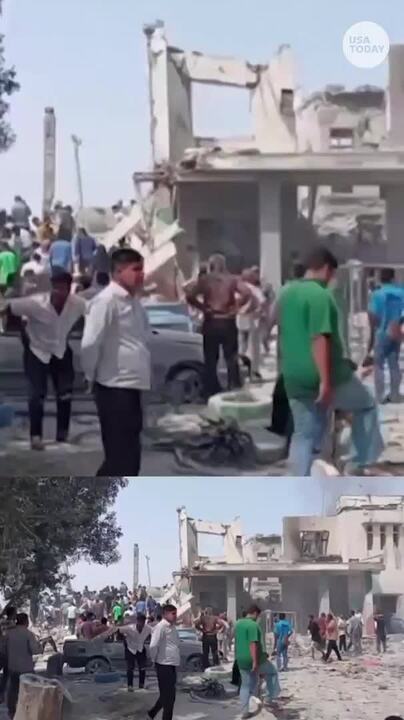
He also referenced what Iran says was a deadly strike on a school in the southern city of Minab. Dozens were killed in the incident, local officials have said.

In an earlier post on X, he shared a photo of dozens of people surrounding a heavily damaged building with smoke rising from the facility, which he said was "bombed in broad daylight, when packed with young pupils."

Iran's foreign minister says he's unsure why U.S. attacked during nuclear talks

Changing theIranian regimeis "mission impossible," the country's foreign minister told NBC News, hours afte...
What US bases did Iran target? Were any Americans killed?

No American servicemembers were killed or wounded in awave of attacksIran launched at U.S. bases across the Middle East in retaliation for the U.S.-Israeli missile strikes on the country on Feb. 28, the U.S. military announced hours later.

USA TODAY

The military "successfully defended" against hundreds of Iranian missiles and drones, and there were "no reports of U.S. casualties or combat-related injuries," U.S. Central Command said in a Feb. 28statementposted to X. "Damage to U.S. installations was minimal and has not impacted operations," the statement said.

There are between 30,000 and 40,000 U.S. troops in the region on any given day, Capt. Tim Hawkins, a spokesperson for Central Command,previously told USA TODAY.

A service center for the U.S. Navy's 5th Fleet, which is headquartered in Bahrain, wasattackedwith missiles, according to the country's communication center.Videoverified by multiple news outlets showed the moment a missile struck near the naval base, leaving a billowing cloud of smoke.

The United States attacked Iran roughly an hour after midnight on Feb. 28, hitting targets to "dismantle the Iranian regime's security apparatus," including the command and control facilities for its Revolutionary Guard Corps, "air defense capabilities, missile and drone launch sites, and military airfields," according to the statement.

<p style=This picture obtained from Iran's ISNA news agency shows the site of a strike on a girls' school in Minab, in Iran's southern Hormozgan province, on February 28, 2026. The strike killed 85 people, according to Iranian media and officials.

According to President Donald Trump, the United States joined Israel in launching military strikes, as well as "major combat operations," to target Iran's missile capabilities. Supreme Leader Ayatollah Ali Khamenei was killed in the joint strikes with Israel on Iran, an Israeli source confirmed to USA TODAY. Trump also confirmed on Truth Social that the leader had been killed.

" style="max-width:100%; height:auto; border-radius:6px; margin:10px 0;" loading="lazy" /> People and rescue forces work following an Israel strike on a school in Minab, Iran, February 28, 2026. People and rescue forces work following an Israel strike on a school in Minab, Iran, February 28, 2026. People and rescue forces work following an Israel strike on a school in Minab, Iran, February 28, 2026. Black smoke rises from a destroyed building at a school where, as the state media reports, several people were killed in an Israeli airstrike, following strikes by the United States and Israel against Iran, in Minab, Iran in this screengrab obtained from a social media video released on February 28, 2026. This picture obtained from Iran's ISNA news agency shows the site of a strike on a girls' school in Minab, in Iran's southern Hormozgan province, on February 28, 2026. The United States and Israel launched strikes against Iran on February 28, with Israel's public broadcaster reporting that supreme leader Ayatollah Ali Khamenei had been targeted, as the Islamic republic retaliated with barrages of missiles at Gulf states and Israel. This picture obtained from Iran's ISNA news agency shows the site of a strike on a girls' school in Minab, in Iran's southern Hormozgan province, on February 28, 2026. The United States and Israel launched strikes against Iran on February 28, with Israel's public broadcaster reporting that supreme leader Ayatollah Ali Khamenei had been targeted, as the Islamic republic retaliated with barrages of missiles at Gulf states and Israel. This picture obtained from Iran's ISNA news agency shows the site of a strike on a girls' school in Minab, in Iran's southern Hormozgan province, on February 28, 2026. The United States and Israel launched strikes against Iran on February 28, with Israel's public broadcaster reporting that supreme leader Ayatollah Ali Khamenei had been targeted, as the Islamic republic retaliated with barrages of missiles at Gulf states and Israel. People gather at the site of a destroyed building at a school where, as the state media reports, several people were killed in an Israeli airstrike, following strikes by the United States and Israel against Iran, in Minab, Iran in this screengrab obtained from a social media video released on February 28, 2026. People gather at the site of a destroyed building at a school where, as the state media reports, several people were killed in an Israeli airstrike, following strikes by the United States and Israel against Iran, in Minab, Iran in this screengrab obtained from a social media video released on February 28, 2026. A view shows the aftermath of an Israel strike on a school in Minab, Iran, February 28, 2026.

85 killed at girls' school in Iran amid US-Israeli strikes, state media reports

This picture obtained from Iran's ISNA news agency shows the site ofa strike on a girls' school in Minab, in Iran's southern Hormozgan province, on February 28, 2026. The strike killed 85 people, according to Iranian media and officials.According toPresident Donald Trump, the United States joined Israel inlaunching military strikes, as well as "major combat operations," to target Iran's missile capabilities. Supreme Leader Ayatollah Ali Khamenei was killed in the joint strikes with Israel on Iran, an Israeli source confirmed to USA TODAY. Trump also confirmed on Truth Social that the leader had been killed.

PresidentDonald Trumphas for monthsthreatened to attack Irana second time, ordering the largest buildup of U.S. troops and military assets in the region since the Iraq War began more than a decade ago. The U.S. military previously dropped penetrating bombs on Iranian nuclear facilities in June.

Advertisement

In the aftermath of the U.S. attack, Iran launched attacks at U.S. allies where American troops are stationed across the region, including Kuwait, Saudi Arabia, Bahrain, Jordan, Qatar and the United Arab Emirates. Videos posted to social media and media outlets showed missiles smashing into urban areas and high0rise buildings.

Video showed smoke rise near a U.S. Navy base in Bahrain after an Iranian missile struck on Feb. 28.

Videos on X also showed a missile taken down over Al Udeid Air Base in Qatar, the forward headquarters for U.S. Central Command. Qatar's Defense Ministrysaidmissiles fired at the base were intercepted.

Three members of Kuwait's armed forces suffered minor injuries from falling shrapnel after Ali Al-Salem Air Base, whichhoststhe 386th Air Expeditionary Wing, came under attack, according to the country'sdefense ministry.

Erbil, a city in Iraq that is home to a U.S. air base, was also hit by missiles, the Iraqi government said in astatement. Witnesses in Al Dhafra, the site of a U.S. air base south of the Emirati capital of Abu Dhabi, also heard explosions, Reutersreported.

Jordan, the home of Muwaffaq al Salti Air Base, which hosts the Air Force's 332nd Air Expeditionary Wing, also intercepted missiles, according to newsreports.

The same could not be said in Iran. According to state media, more than 200 people were killed and more than 700 injured across Iran in the attack, including40 at a girls' schoolin the country's south.

This article originally appeared on USA TODAY:What US bases did Iran target? Were any Americans killed?

What US bases did Iran target? Were any Americans killed?

No American servicemembers were killed or wounded in awave of attacksIran launched at U.S. bases across the Middle East i...


VINCE JRNL © 2015 | Distributed By My Blogger Themes | Designed By Templateism.com